Updated: May 2026.
Google Maps WikipediaYou have landed at O'Hare, your hotel is downtown, and the cheapest route is staring at you from the airport in the form of the CTA Blue Line. This is good news, unless you have three bags, a half-dead phone, and a hotel that is "near downtown" in the way airport coffee is "near affordable."
The cheap route is best when the full route stays simple: airport station, direct train, correct downtown stop, short final walk. If any of those pieces gets messy, compare a direct ride before you commit.
The table below is a first decision filter, not a replacement for checking your exact hotel block. Downtown Chicago has enough station choices that one stop can create a clean five-minute walk while another creates a wet, windy, luggage-dragging regret parade.
This guide compares the cheapest practical ways from ORD to downtown Chicago: CTA Blue Line, taxi, rideshare, and the moments when saving money becomes a bad hobby. For the bigger city plan, use the Chicago practical guide.
Quick answer
The cheapest useful way from ORD to downtown Chicago is usually the CTA Blue Line, especially for solo travelers or couples with manageable luggage staying near a Blue Line or Loop station.
Key details
Check the specific details for your visit timing and booking method. Prices, schedules, and availability change seasonally, so verify before you go.
Practical tips
Check the specific details for your visit timing and booking method. Prices, schedules, and availability change seasonally, so verify before you go.
Use taxi or rideshare when your hotel is not close to a station, your group has heavy luggage, you arrive very late and tired, or the final walk looks miserable. A cheap train plus a bad last mile is not a win. It is a budget trap with stairs.
Train, taxi, or rideshare: the fast decision
Use this table as a first sort, then check the exact hotel block. The cheapest route is not simply airport-to-Loop. It is airport-to-your-door with your actual bags, your arrival time, and your tolerance for a final walk.
| Situation | Best default | Why |
|---|---|---|
| Solo traveler, light bag, Loop hotel | CTA Blue Line | Direct airport rail, runs 24 hours, avoids road traffic. |
| Family, stroller, multiple bags | Taxi or rideshare | Fewer stairs, fewer transfers, less group management. |
| Late arrival with low battery | Taxi if the train route is not obvious | A direct ride beats improvising downtown exits at midnight. |
Why the Blue Line is the cheapest default
CTA says the Blue Line provides 24-hour rapid transit service between Chicago-O'Hare International Airport and Forest Park via downtown. FlyChicago also describes the Blue Line as the easiest and most affordable public-transit route between O'Hare and Chicago.
The O'Hare station is inside the airport system, so the first move is not complicated: follow signs for trains to the destination or CTA Blue Line. Do not follow regional bus, rental car, or hotel shuttle logic unless you are doing one of those things. Airport signs are not a personality test, but they do reward people who know their first target.
Best for: travelers staying near Clark/Lake, Washington, Monroe, Jackson, LaSalle, or another downtown Blue Line stop, and travelers who can manage their luggage without needing an elevator every five minutes.
Watch out: the train may be cheap, but the final walk still matters. A hotel six blocks from a station can be fine at 2 p.m. with a backpack. It is much less useful at 11:40 p.m. with rain, wind, and a suitcase wheel that has joined organized crime.
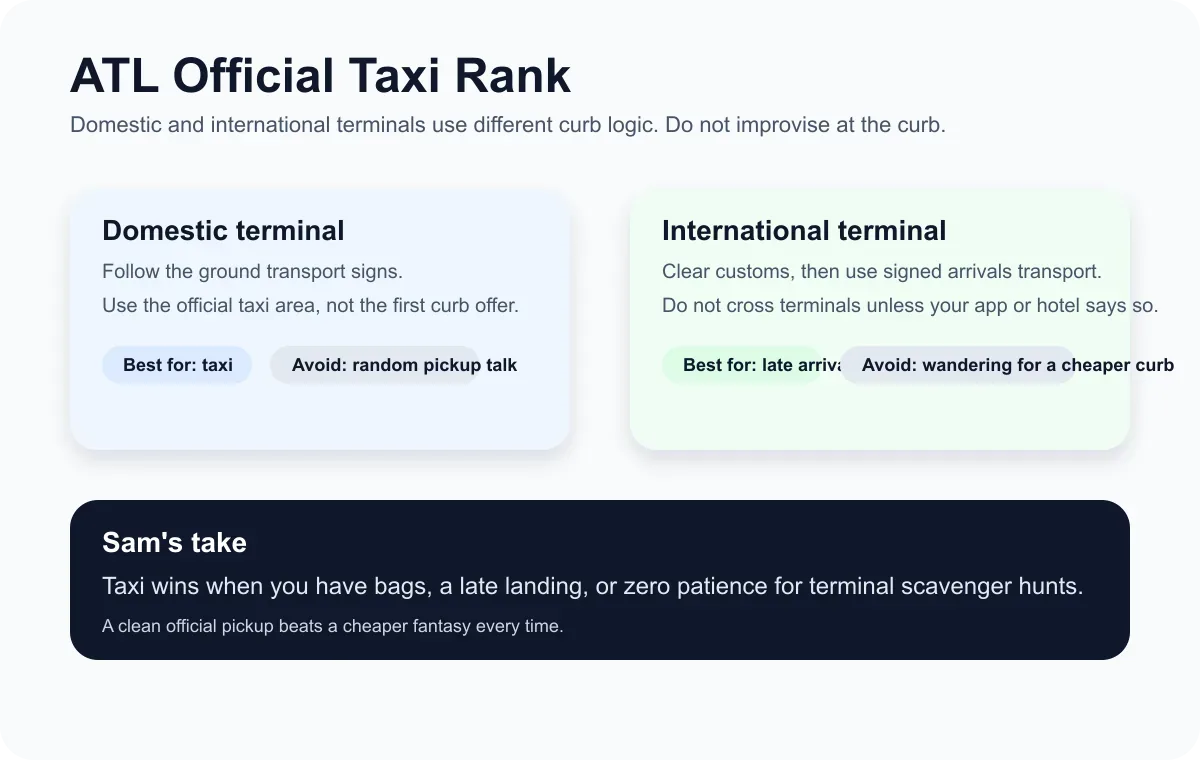
Taxi and rideshare: more money, fewer handoffs
FlyChicago says taxis are available at O'Hare and notes an average fare from O'Hare to downtown Chicago of about $50, depending on traffic. Rideshare pricing can swing with demand, weather, events, and airport congestion. The cheaper car option changes by the hour, because apps enjoy chaos as a business model.
Use taxi/rideshare if: your group is larger, your hotel is not near the Blue Line, you arrive late, or your luggage makes public transit annoying. If you are staying in River North, West Loop, Streeterville, or South Loop away from a convenient Blue Line stop, a direct ride may be worth it.
Recovery step: if app pricing looks ugly, check the official taxi line. If the taxi line is long, compare rideshare again. The right answer at ORD is often whichever official option gets you moving cleanly.
The real cost test
The train is cheapest when it gets you close enough to the hotel that you do not need a second ride. If you need rideshare after the train, compare that combined cost against a direct ride from ORD. The cheapest route on paper can lose if the final mile is awkward.
Rule: train plus short walk is good. Train plus long walk, stairs, rain, and a second ride is usually not the bargain it pretends to be.
Blue Line step-by-step from O'Hare
After baggage claim, follow signs for CTA trains or trains to the destination. The Blue Line is the airport rail route into downtown Chicago. Before you board, check that your hotel station is actually on or near the Blue Line. Do not board first and solve the hotel problem later. That is how a cheap train becomes a downtown guessing game.
Once on the train, stay aware of your stop sequence and keep luggage close. If your hotel is in the Loop, you may have several possible stations. Pick the one with the shortest clean walk, not the one whose name you recognize from a map you saw once in a hurry.
What to do if you miss your stop: do not panic-exit at a random station. Check the next stop, decide whether to ride back, continue forward, or take a short rideshare from where you are. One missed stop is annoying. Turning it into three wrong moves is optional.
Who should not take the cheapest route
Travelers with mobility needs: check elevator availability and the final station before relying on the Blue Line. A cheap fare does not help if the last station or final walk is not manageable.
Families with strollers: the train can work, but only if the final walk is short and the group can move through stations calmly. If everyone is tired, a direct ride may be worth the cost.
Travelers heading outside the Loop: if your hotel is in River North, Streeterville, Lincoln Park, or another area not cleanly served by the Blue Line, compare the whole route. The cheapest airport-to-downtown route is not always the cheapest airport-to-your-hotel route.
Practical verdict
Take the CTA Blue Line if you are traveling light, your hotel is near a usable station, and you want the cheapest reliable route. Take taxi or rideshare if the final walk is bad, the group is overloaded, or your arrival time makes train-plus-walk feel like a small punishment. Do not save a few dollars if it buys you a 40-minute luggage documentary downtown.
What to recheck
Also recheck the page on the day before travel if your plan depends on a specific shuttle, train, parking product, or late-night service. The safest plan is the one that still works when one timing detail changes.
Recheck official transport pages close to travel because fares, shuttle locations, service alerts, and parking rules can change. Use the links below as the source trail, then verify live timing before you build a nonrefundable plan around it. If an official page and a booking snippet disagree, trust the official page first and contact the provider before paying.
FAQ
What is the cheapest way from ORD to downtown Chicago?
The CTA Blue Line is usually the cheapest practical route from ORD to downtown Chicago. It runs 24 hours and serves downtown stations, but the final walk to your hotel matters.
Is the Blue Line from O'Hare to downtown direct?
Yes. The Blue Line runs from O'Hare through downtown Chicago. Check your exact hotel station before boarding so you do not create a bad final walk.
When should I skip the Blue Line?
Skip it if you have heavy luggage, children, mobility needs, a hotel far from the station, or very low phone battery late at night. In those cases, taxi or rideshare can be the calmer option.
Travel insurance is one of those things you do not need until you desperately do. A cancelled flight, lost luggage, or unexpected medical issue can turn a budget trip into an expensive disaster. Check whether your credit card already includes travel coverage before buying a separate policy.
Carry a pen for filling out immigration forms and customs declarations on the plane. The flight attendants often run out, and buying one at the airport shop costs more than it should. A pen weighs nothing and saves you from awkward borrowing.
Photocopy your passport and save it as a photo on your phone. If your passport is lost or stolen, having a copy speeds up the replacement process at the embassy. Keep the original in the hotel safe and carry the copy during day trips.
Check the local tipping culture before you arrive. Tipping norms vary enormously between countries. In some places, tipping is expected and significant. In others, it is unnecessary or even awkward. Knowing the local norm prevents uncomfortable moments at restaurants.
Download a translation app that works offline. Google Translate and similar apps can translate text, voice, and even camera images without an internet connection. Download the language pack for your destination before you leave home Wi-Fi.
Bring a reusable water bottle. It saves money, reduces plastic waste, and ensures you stay hydrated during long walking days. Many cities have public water fountains that are safe to drink from. Fill up before heading out each morning.
Related guides
- ORD Terminal 5 International Arrivals 2026: Customs, Bags, E
- ORD Arrival After Midnight 2026: Train, Taxi or Hotel?
- Park Sleep Fly Near ORD 2026: O'Hare Parking Guide
- Best Hotels Near ORD Airport With Free Breakfast 2026
- Hotels Near Gare du Nord With Late Check-In 2026
- Hotels Near Gare du Nord With Parking Guide 2026
Sam's practical verdict
Sam's practical verdict: The best transfer choice depends on your bags, your arrival time, and your hotel location. Do not choose based on price alone. Choose based on the moment that is most fragile: heavy bags, late arrival, tired children, or a hotel that is far from public transport.
- World Cup 2026: Getting Back to Your Hotel After Midnight
- ORD Terminal 5 International Arrivals 2026: Customs, Bags, Exit
- ORD Arrival After Midnight 2026: Train, Taxi or Hotel?
- Park Sleep Fly Near ORD 2026: O'Hare Parking Guide
- Best Hotels Near ORD Airport With Free Breakfast 2026
- Chicago Travel Guide 2026: Areas, Transit, 3-5 Days
- World Cup 2026: Getting Back to Your Hotel After Midnight
- ORD Terminal 5 International Arrivals 2026: Customs, Bags, Exit
- ORD Arrival After Midnight 2026: Train, Taxi or Hotel?
- Park Sleep Fly Near ORD 2026: O'Hare Parking Guide
- Best Hotels Near ORD Airport With Free Breakfast 2026
- Chicago Travel Guide 2026: Areas, Transit, 3-5 Days