Updated: May 2026
Berlin is the city where first-timers most often make the same planning mistake: they treat it like a compact capital with one obvious center. It is not. Berlin is large, neighborhood-led, and rewarding only when the day has a clear anchor. A route that looks normal on a map can become tiring once it includes museum time, transit platforms, meals, late-night returns, and a hotel that is technically central but wrong for your trip.
This guide is the starting page for the first Berlin decision: where to stay, how to arrive from BER, how ticket zones work, what to do by area, and how to build a 3 to 5 day plan that does not turn into cross-city zig-zagging. If one decision becomes the real problem, use the specialist pages: where to stay in Berlin, BER to Berlin city center, Berlin public transport tickets, or the Berlin itinerary guide.
Quick answer
For most first-time visitors, Berlin works best as a 4-day trip based in Mitte, Prenzlauer Berg, Friedrichshain, Charlottenburg, or a carefully chosen Hbf edge. Plan one main area or anchor per day. Use train from BER for most daytime arrivals, taxi for late or heavy-luggage arrivals, and do not mix too many far-apart neighborhoods in one day.
Key details
Check the specific details for your trip timing and booking method. Prices, schedules, and availability change seasonally, so verify before you go.
Berlin in plain language
Berlin is not hard because transport is weak. It is hard because transport makes too many combinations possible. A first-timer can link Museum Island, Kreuzberg, Charlottenburg, East Side Gallery, Prenzlauer Berg, and a late dinner in one theoretical day. The better trip chooses fewer areas and gives them room.
Think in chapters. Mitte and Museum Island are the classic first chapter. Prenzlauer Berg is calmer and better for mornings. Friedrichshain and Kreuzberg are stronger for nightlife and edge. Charlottenburg is more comfortable and useful for families or travelers who want a softer base. Berlin Hbf is a tool, not automatically the emotional center of the trip.
Where to stay in Berlin
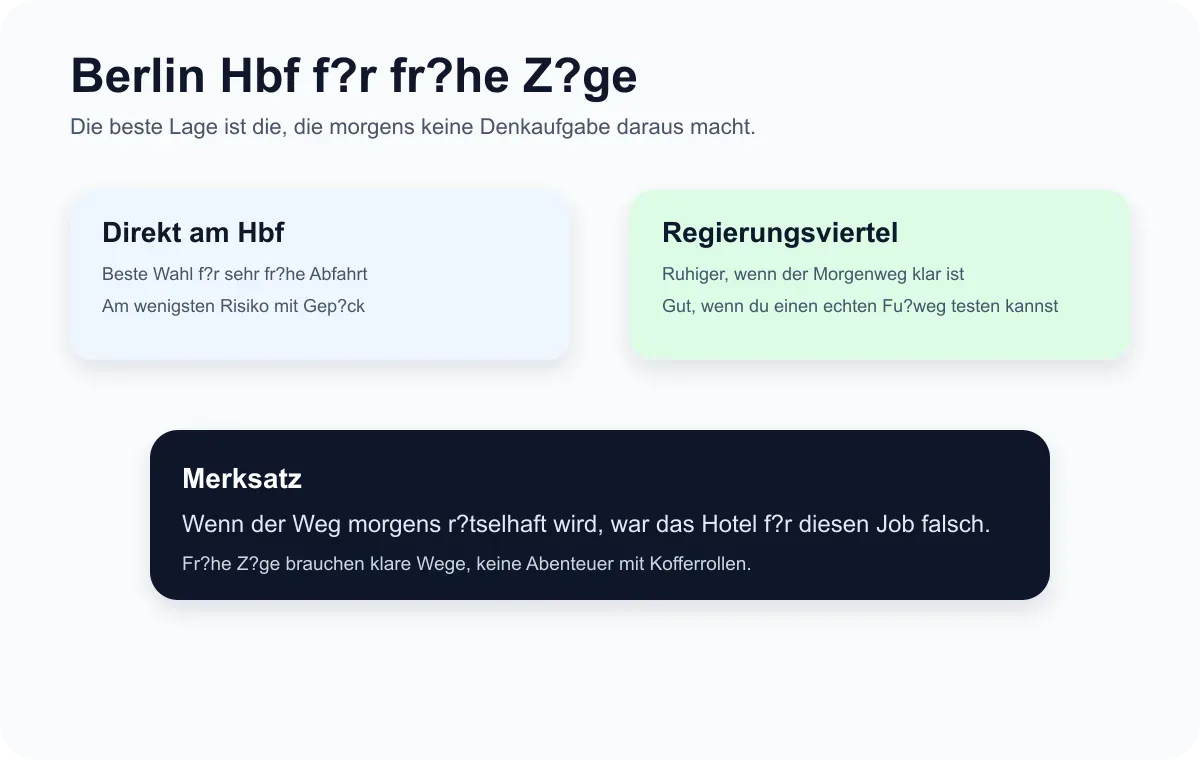
Pick the area by the trip you actually want. Mitte is the easiest if sightseeing is the point. Prenzlauer Berg works if you want a neighborhood that feels calm after dinner. Friedrichshain and Kreuzberg work if nightlife and younger energy matter. Charlottenburg works if comfort, shopping, and family-friendly pacing matter. Hbf edges are useful when trains control the trip.
| Area | Best for | Watch out for |
|---|---|---|
| Mitte | Classic sights, museums, first-time orientation | Can feel too functional if you want neighborhood evenings |
| Prenzlauer Berg | Calmer mornings, cafes, families, couples | Less direct for some classic sights |
| Friedrichshain / Kreuzberg | Nightlife, bars, younger city energy | Pick street carefully if sleep matters |
| Charlottenburg | Comfort, shopping, families, quieter evenings | Less sharp for nightlife-heavy trips |
BER airport arrival: train first, taxi when the last mile is weak
Official BER and VBB information points travelers to rail, S-Bahn, regional trains, the Flughafen-Express, buses, and apps for tickets. VBB also notes that trips between BER and central Berlin require an ABC ticket. The practical rule is simple: train is the default for most daytime arrivals, but the final hotel step decides whether that default still feels good.
If your hotel is near a clean rail or S-Bahn connection, use rail. If your hotel needs a confusing transfer, a long final walk, stairs, children, or a late-night check-in, taxi may be the better arrival-day choice even if the train is technically efficient. A good BER arrival is not the fastest route on paper. It is the route you can still execute when tired.
Tickets and getting around
Berlin ticket confusion usually starts with zones. Airport trips are not the same as inner-city hops. Solve the airport ride first, then decide whether the rest of the day needs a simple single ticket, day ticket, or pass. Do not stand at BER trying to solve the whole week.
Inside the city, the better rule is area-first movement. Use U-Bahn, S-Bahn, tram, or bus to reach the day's chapter, then walk more within that chapter. Berlin feels worse when every 20 minutes becomes another transfer.
A calm 4-day Berlin plan
Arrival day: Mitte orientation or hotel-neighborhood reset
Keep it simple. Arrive from BER or Hbf, learn the nearest station, eat near your base, and do one short orientation walk. Do not force the biggest museum or nightlife plan onto the arrival day.
Museum and classic Berlin day
Use this for Museum Island, Brandenburg Gate, Reichstag area, Unter den Linden, or another classic first-timer anchor. Choose one or two major interiors, not five.
Neighborhood day
Pick Prenzlauer Berg, Kreuzberg, Friedrichshain, Neukolln, or Charlottenburg depending on your style. This is where Berlin starts feeling like a city rather than a monument list.
Flexible day: history, parks, food, or Potsdam
Use the final full day for the layer your trip is missing. If the first days were museum-heavy, slow down. If the weather is good, add parks or a more outdoor route. If you have five days, Potsdam becomes easier without stealing Berlin's core time.
Weather and season planning
Berlin changes a lot by season. Summer rewards parks, Spree-side evenings, outdoor food, and late wandering, but it also makes popular museum and landmark areas busier. Winter makes indoor anchors more important and turns a weak hotel location into a bigger problem because extra transfers feel worse in cold rain. Spring and autumn are usually the easiest seasons for first-timers because walking remains pleasant and the city has enough indoor fallback.
The practical move is to keep each day flexible inside one area. If the weather turns while you are in Mitte, switch to museums or a longer meal instead of crossing the city for a different plan. If the weather is good while you are in Prenzlauer Berg, Friedrichshain, Kreuzberg, or Tiergarten, give the outdoor part more time and cut a lower-priority indoor stop.
Families, luggage, and low-energy days
Berlin can be very good with families, but only if the daily geography is honest. The distances are larger than many first-timers expect, and stations, platforms, and transfers can wear down children faster than the sightseeing itself. A family plan should use fewer areas per day, earlier meals, and a hotel near a line that is useful every day, not just close to one attraction.
With heavy luggage, the same rule applies: make arrival boring. A beautiful neighborhood stay is not a win if the first night requires two transfers and a long final walk. If the arrival is late, choose the easiest hotel handoff first, then let Berlin become interesting the next morning.
Common Berlin mistakes
Booking by centrality alone: central Berlin is not one mood. Pick the base by evening style and transit fit.
Overusing transit: use transit to reach an area, then walk the area.
Underestimating BER arrival: the train is often right, but the last hotel step still matters.
Doing too many museums in one day: Berlin rewards focus more than institutional volume.
Ignoring late-night returns: nightlife areas are easier when the way back is already understood.
Getting Around Berlin on a Budget
Public transport day passes are almost always cheaper than individual tickets if you plan to make more than 3 trips. Many cities also offer tourist cards that bundle transit with attraction discounts. Check if the math works for your itinerary before buying.
Walking is often the best way to understand a city. Berlin has distinct neighborhoods, and the transition between them tells a story that buses and trains miss. Wear comfortable shoes and carry water, especially in summer.
The best travel experiences in Berlin happen when you slow down. Instead of rushing between five attractions in a day, pick two and spend quality time at each. You will remember a relaxed afternoon at a local market far longer than a rushed visit to a museum.
Carry a small notebook or use your phone to jot down the names of restaurants, streets, and neighborhoods that locals mention. The best recommendations come from conversations, not from guidebooks. Writing them down means you will actually remember them tomorrow.
Local tourism offices sometimes offer free walking tours, discount cards, and practical advice that is better than any online source. Visit the office on your first day and ask what is happening that week. Events, markets, and festivals that are not in guidebooks often show up here.
Many attractions offer discounted tickets in the late afternoon or on specific days of the week. Check the official website for reduced hours and special offers. A museum that costs full price at 10 AM may be half-price after 4 PM.
Learn three phrases in the local language: hello, thank you, and excuse me. These open more doors than any phrasebook app. Locals appreciate the effort even if your pronunciation is terrible, and it changes the tone of every interaction.
Pocket tissues are useful in more situations than you expect. Not every public restroom has paper towels or hand dryers, and some local eateries use napkins sparingly. A small pack weighs nothing and solves a dozen small daily inconveniences.
The best travel experiences in Berlin happen when you slow down. Instead of rushing between five attractions in a day, pick two and spend quality time at each. You will remember a relaxed afternoon at a local market far longer than a rushed visit to a museum.
Carry a small notebook or use your phone to jot down the names of restaurants, streets, and neighborhoods that locals mention. The best recommendations come from conversations, not from guidebooks. Writing them down means you will actually remember them tomorrow.
Local tourism offices sometimes offer free walking tours, discount cards, and practical advice that is better than any online source. Visit the office on your first day and ask what is happening that week. Events, markets, and festivals that are not in guidebooks often show up here.
Related guides for Berlin
Berlin rewards travelers who plan ahead but leave room for spontaneous discoveries. The best experiences often come from wandering side streets, trying local food at neighborhood restaurants, and talking to locals about their recommendations. A good city guide gives you the framework, but the real trip is what you make of it.