World Cup 2026 airport to stadium

Updated: June 2026.

You land at 2 PM. Your match kicks off at 5 PM. Your hotel is somewhere between the airport and the stadium. And you have no idea how long the transfer actually takes.

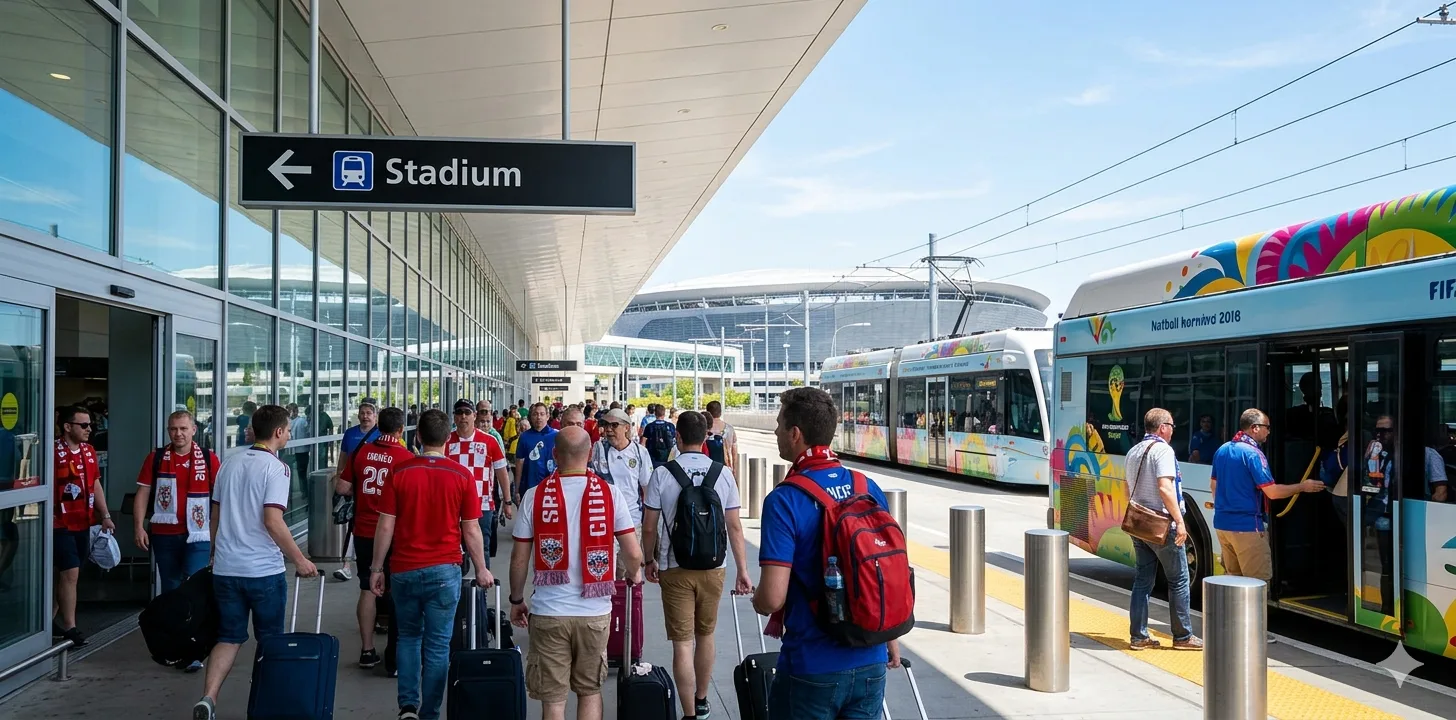
This is the problem that ruins more match days than anything else. Fans underestimate the airport-to-stadium commute and end up missing kickoff or arriving stressed, hungry, and late. This guide covers the exact route from each host city airport to the stadium: what to take, how long it really takes, and what goes wrong for first-timers.

Quick answer

For most host cities, public transit from the airport to the stadium is your best bet before the match. Atlanta, Seattle, and Philadelphia have the easiest direct rail connections. Boston, New York, and Dallas require transfers or long ride-share trips. The safest move: give yourself 3 hours from landing to stadium seat for easy connections, 4 hours for the complicated ones. Do not attempt any of these routes in under 2 hours.

Seattle: Light Rail from SeaTac to Lumen Field

SeaTac Airport has Link Light Rail service that takes you directly downtown. Board the train at the SeaTac station connected to the terminal. Ride 11 stops to the International District / Chinatown station, which is a 5-minute walk from Lumen Field gates. Total time from baggage claim to stadium seat: roughly 40 minutes. Fare is $3.25 each way. The train runs every 8 to 15 minutes depending on time of day. The station platform can get packed on match days. Walk to Pioneer Square station (one stop south) for a less crowded boarding if needed.

Atlanta: MARTA from ATL to Mercedes-Benz Stadium

Hartsfield-Jackson has a MARTA station directly inside the terminal. Take the Gold or Red Line north to the Dome / GWCC / CNN Center station. The train ride is about 15 minutes and costs $2.50 each way. The Dome station is directly under the stadium. This is the easiest airport-to-stadium connection in the entire tournament. If you have extra time before the match, get off at Five Points station (one stop earlier) and walk through the CNN Center for the indoor route to the stadium, which is air-conditioned and has food options. MARTA runs every 10 to 12 minutes on regular schedules.

Philadelphia and Los Angeles: Rail with One Transfer

Both cities have good rail options from the airport that require a single transfer before reaching the stadium.

Philadelphia (PHL to Lincoln Financial Field). The SEPTA Airport Line runs from the PHL terminal to 30th Street Station. Transfer there to the Broad Street Line south to NRG Station. The total trip is about 45 minutes and costs $6.75 each way. SEPTA usually extends service for major events at the stadium complex. The walk from NRG Station to the Linc is about 5 minutes. If you miss a connection, the Airport Line runs roughly every 30 minutes.

Los Angeles (LAX to SoFi Stadium). Take the free LAX Shuttle to the Aviation / Century station on the Metro K Line. Ride the K Line to the Downtown Inglewood station. From there, Metro runs free World Cup shuttle buses to SoFi Stadium. Total time is about 60 to 75 minutes. The Metro fare is $1.75 each way. The return shuttle after the match can have long queues, so budget extra time. If you prefer a direct route, a ride-share from LAX to the stadium costs roughly $25 to $40 without surge pricing. Also see the LAX Late Night guide for more details.

Miami and Houston: No Direct Rail to the Stadium

These two cities require a ride-share or shuttle for the final leg to the stadium from the nearest transit stop.

Miami (MIA or FLL to Hard Rock Stadium). Miami International has the MIA Mover to the Tri-Rail station. Tri-Rail runs limited service to the Golden Glades station. From there, stadium shuttle buses operate on match days. Total time from MIA: about 90 minutes by transit, or 35 minutes by ride-share ($30 to $45). Fort Lauderdale (FLL) is closer at about 25 minutes by ride-share ($25 to $35). The stadium has no direct rail connection, so most fans drive or use ride-share. Pre-book parking through JustPark at $175 to $200.

Houston (IAH or HOU to NRG Stadium). From Bush Intercontinental (IAH), take METRO Bus 102 to the Northline Transit Center, then transfer to the METRORail Red Line south to Stadium Park / Astrodome station. Total time: roughly 75 minutes. Fare is $1.25 each way, the cheapest transit option in the tournament. From Hobby (HOU), take Bus 40 to the Red Line. A ride-share from IAH to NRG costs about $35 to $50. The Red Line runs until roughly 1 AM, which covers most match schedules.

Kansas City and Dallas: Car Territory

These two stadiums have essentially no public transit from the airport. You will need a ride-share or rental car.

Kansas City (MCI to Arrowhead Stadium). MCI has no rail connection to the city. A shuttle bus runs from the airport to downtown Kansas City, but service is limited. A ride-share from MCI to Arrowhead costs about $50 to $70. The ConnectKC26 match-day bus runs from designated park-and-ride locations near the stadium. Parking at Arrowhead costs $75 to $100 and must be pre-booked. Your best bet is to rent a car or reserve a ride-share in advance.

Dallas / Fort Worth (DFW to AT&T Stadium in Arlington). DFW has the Trinity Railway Express (TRE) that runs to CentrePort station, but the TRE does not serve Arlington where the stadium is located. There is no rail, no subway, and no direct bus to AT&T Stadium. A ride-share from DFW to the stadium costs about $25 to $40. From Love Field (DAL), a ride-share costs about $30 to $45. Pre-book parking at $75 to $125 through JustPark. Return traffic after the match takes 60 to 90 minutes to clear.

San Francisco Bay Area: BART Plus VTA

Levi Stadium is 45 miles south of San Francisco in Santa Clara. The route requires a BART ride and a VTA connection.

From San Francisco International (SFO), take BART to the Berryessa / North San Jose station. The ride takes about 45 minutes. Transfer there to the VTA light rail Orange Line toward Santa Clara. The VTA stop for Levi Stadium is Great America / Levi Stadium station. Total time from SFO: about 75 to 90 minutes. BART fare is roughly $8 to $10 each way. VTA fare is $2.50 each way. BART runs until around midnight on weeknights and 9 PM on Sundays. If your match ends after 10 PM, the safer option is to park at the stadium or use a ride-share from SFO directly, which costs about $50 to $80. Booking a hotel in Santa Clara or Sunnyvale instead of San Francisco cuts the post-match return time dramatically.

Boston and New York: The Longest Transfers

These two host cities have the longest and most complex airport-to-stadium routes. Do not underestimate these transfers.

Boston (BOS to Gillette Stadium in Foxborough). Take the MBTA Silver Line from Logan to South Station. From South Station, the MBTA Commuter Rail runs match-day trains to Foxborough station. The train takes about 45 minutes and runs only on event days with specific schedules. Total time from landing to stadium: about 90 minutes with good connections. If you miss the commuter train, a ride-share from Logan to Gillette costs $100 to $150. The practical approach for late-arriving flights is to book a hotel near the stadium in Foxborough or Providence, Rhode Island, rather than downtown Boston.

New York / New Jersey (JFK, EWR, or LGA to MetLife Stadium). MetLife has the most complex transfer of any host venue. There is zero on-site spectator parking, so all fans must use NJ Transit Rail from Secaucus Junction plus a stadium shuttle. From JFK: AirTrain to Jamaica, LIRR to Penn Station, NJ Transit to Secaucus, then the shuttle. From Newark (EWR): NJ Transit direct to Secaucus, then the shuttle. From LaGuardia (LGA): a bus to Penn Station, then NJ Transit. Total time from any airport: roughly 90 to 120 minutes. The return shuttles are capped and frequently sell out. Pre-buy your return NJ Transit ticket online. If the shuttle line is more than 100 deep, walk to the American Dream Mall next door and order a ride-share from there. The JFK Airport Guide covers terminal pickup and regional transit in more detail.

Common Airport-to-Stadium Mistakes

Assuming the return trip takes the same time as the arrival trip. Post-match transit runs on reduced schedules, and ride-share prices surge 2 to 4 times after the final whistle. The route that took 40 minutes before the match can take 90 after it.

Not accounting for baggage. If you land and go straight to the stadium with luggage, check if the stadium has bag storage. Most do not. Plan to check into your hotel first or leave bags at a luggage storage service near the stadium.

Trusting your phone for tickets and directions. Cell towers get congested with 70,000 people. Download your train tickets and stadium entry pass before you leave the airport. Screenshot the transfer directions.

Taking a ride-share from the airport without checking match-day traffic. A 30-minute ride can turn into 90 minutes on match day. Compare transit and ride-share ETA before you decide. Do not choose ride-share just because it looks simpler.

Missing the last train back. Check the return schedule before you leave the airport, not when the match ends. Some stations close early on weekends. If the last train is too early, pre-book a ride-share or parking spot.

FAQ

Which host city has the easiest airport-to-stadium connection?

Atlanta (ATL to Mercedes-Benz Stadium via MARTA) and Seattle (SeaTac to Lumen Field via Link Light Rail) are the easiest. Both are direct rail connections from the airport terminal to a station steps from the stadium.

Which host city has the hardest airport-to-stadium connection?

New York / New Jersey (any airport to MetLife) is the hardest due to two transfers plus a shuttle, capped return service, and no parking. Boston (Logan to Gillette) and Dallas (DFW to AT&T) are close behind.

Should I rent a car for World Cup match day?

Only for Kansas City (Arrowhead) and Dallas (AT&T Stadium), where public transit is absent. For all other host cities, the cost of parking ($75 to $200) plus traffic delay makes transit or ride-share the better choice.

How much time should I budget from landing to stadium seat?

3 hours for easy connections (Atlanta, Seattle, Philadelphia). 4 hours for medium connections (LA, Houston, San Francisco). 5 hours for the hard ones (Boston, New York, Miami). This includes baggage claim, transit time, and walking to your seat.

Can I go straight from the airport to the stadium with luggage?

Most stadiums do not have bag storage for fans arriving directly from the airport. Plan to drop luggage at your hotel first or use a luggage storage service near the stadium. Some stations have lockers, but availability on match day is not guaranteed.

Sam's Practical Verdict

For most World Cup match days, public transit from the airport beats a ride-share or rental car. The transit routes are established, the stadium stops are well marked on match days, and you skip the match-day traffic that clogs the highway exits near every venue. The exceptions are Kansas City and Dallas, where you have no real choice but to drive or take a ride-share. The single most important thing you can do: check the return schedule before you leave the airport, not when the match ends. Everything else is fixable. Missing the last train back is not.

Related guides

Sources: FIFA World Cup 2026 official site, Sound Transit, MARTA, SEPTA, LA Metro, Tri-Rail, METRO Houston, ConnectKC26, Trinity Railway Express, BART, VTA, MBTA, NJ Transit, JustPark. Schedules and fares current as of June 2026.