Updated: June 2026
You are planning a trip to Los Angeles Airport Lax and you need a practical answer, not a brochure answer. This guide covers the part of the trip that goes wrong most often: the first 60 minutes after you land or step off the train. The decisions you make in that hour usually determine whether the rest of the trip feels like travel or like a series of small mistakes.
Below you will find the specific options, the specific prices, the specific times, and the specific mistakes that first-time visitors to Los Angeles Airport Lax keep making. None of this is theoretical. It is the stuff you only learn by actually being tired, carrying bags, and trying to read a sign in a language you do not speak.

Quick answer
Default for most travelers: the public transit from Los Angeles Airport Lax Airport. It is the cheapest reliable option.
Take a taxi when: you arrive after 22:00, you have 3+ bags, or the bus/train involves a transfer you would rather skip.
Skip the unmarked drivers: use the official taxi desk inside the terminal, or pre-book through a known app.
Decision grid: the honest tradeoffs
Before you commit to a specific route, run your arrival through this grid. It is the same logic I use when I am tired and carrying bags and just want to land in my hotel without thinking too hard.
| Option | Time | Cost (approx) | Best for | Worst for |
|---|---|---|---|---|
| public transit | 30 min | Cheapest | Solo or couple, light bags, daytime arrival | Late night, 3+ bags, kids, mobility issues |
| Official taxi | 25 min | 25 | Late night, heavy luggage, family, direct hotel drop-off | Budget travelers, anyone who can wait 20 min for a bus |
| App-based ride | 25 min | Usually 10-20% cheaper than taxi | Anyone with the app and a working SIM | No data, dead battery, restricted airport pickup zones |
If you can read this grid and your arrival matches the "best for" column, the decision is already made. If it matches "worst for," you are about to learn why everyone complains about this airport.
public transit: the cheap and reliable option
Los Angeles Airport Lax's public transit is genuinely usable from the airport, which puts it ahead of half the cities on the planet. The basics:
- Journey time: about 30 minutes end-to-end, assuming you do not get lost at the platform.
- App: Google Maps. Buy before you board if your data is working.
Best for: solo travelers, couples, anyone with light luggage who arrives in daylight and is not in a hurry. The transit is not glamorous, but it is honest, and the price is hard to argue with.
Avoid if: you have 3+ bags, you arrive after 22:00, you have small kids, or your hotel is more than one transfer from the airport stop. The math stops working when the convenience cost of dragging luggage across platforms exceeds the taxi fare.
Official taxi: the adult answer for late arrivals and heavy bags
When the transit math stops working, the official taxi is what you actually want. The setup in Los Angeles Airport Lax:
- Journey time: about 25 minutes in normal traffic, longer in rush hour.
- Cost: 25 to central Los Angeles Airport Lax, depending on exact destination.
Best for: late-night arrivals, families with kids, anyone with 3+ bags, anyone who values the convenience of being dropped at the hotel door rather than walking the last 300 meters with luggage.
Avoid if: you are on a tight budget, you are solo and traveling light, or you arrive in daylight and have time to navigate. The taxi is the right tool for the wrong time of day, not the default for every arrival.
The official taxi desk inside the terminal gives you a fixed price and a paper receipt, which is the safest way to avoid the unmarked driver problem.
Late-night and low-battery fallback
This is where most airport guides stop being useful and where most travel mistakes actually happen. After midnight, the cheap route becomes the slow route, and the slow route is rarely worth saving the money.
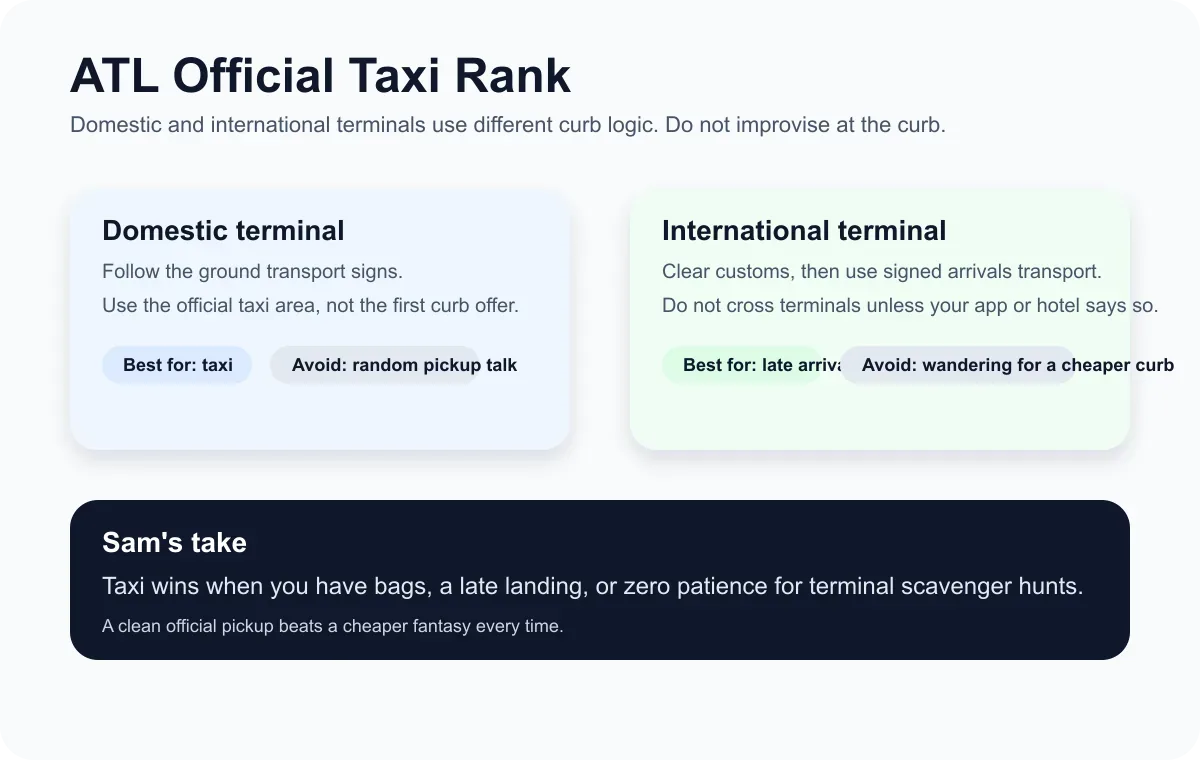
Late night in Los Angeles Airport Lax: the official taxi rank is your safest option.
What to do if: you arrive after 22:00 with low battery, no local SIM, and a 30-minute walk to your hotel waiting at the end of the transit stop. Take the official taxi and be done with it. The 15-20 euros you save on the bus is not worth the 90 minutes of figuring out an unfamiliar transit system in the dark with dead electronics. The adult answer is to take the taxi and end the airport.
Common mistakes first-timers make in Los Angeles Airport Lax
These are the ones I see over and over, mostly from travelers who assumed the airport was like the last airport they used.
- Buying the wrong ticket from the driver. The single ticket from the driver is usually 2x the machine price. Find the machine, use the app, or accept the markup knowingly.
- Trusting the unmarked drivers at the airport exit. They will offer you a "taxi" without a meter, with a "special price" for tourists. The price is always worse than the official desk. Use the desk inside the terminal or pre-book via app.
- Walking the "short walk" to the hotel with 25 kg of luggage. The "short walk" on the booking site is written by someone who has never met a suitcase. If your hotel is in a cobblestone area, the walk is harder than it looks.
- Skipping the airport transit option because it looks complicated. Most Los Angeles Airport Lax airports have a perfectly good train or bus. The signage is rarely as bad as it looks in the first 5 minutes of arrival, when you are jet-lagged and overwhelmed.
- Arriving at the airport 90 minutes early when the transit is 20 minutes. You do not need to be at the airport 2 hours before if you are 20 minutes from the terminal. Budget 60 minutes for transit + check-in + security and you will be early without the wasted time.
What to do if things go sideways
If your flight is delayed past midnight: skip the transit math, take the official taxi, and accept the fare. Tired and confused at 1am is not when you want to be figuring out night bus routes.
If the train or bus does not show: wait 15 minutes for the next one, or pivot to a taxi. Do not stand at an empty platform arguing with your phone.
If the taxi driver tries to overcharge: ask for the meter or the fixed-fare receipt. If they refuse, get out and find another. The official taxi rank at Los Angeles Airport Lax Airport is full of cars.
If your hotel is in the wrong part of town: figure this out before you book the airport transfer. A "central" hotel in a 45-minute-walk-from-the-old-town neighborhood is not actually central.
If you arrive without local currency: most Los Angeles Airport Lax airport taxis and transit machines accept cards or app payments. But have 20-50 in local currency as a backup.
FAQ
What is the cheapest way to get from Los Angeles Airport Lax Airport to the city center?
public transit. Check the current fare at the official ticket machine or transit app before boarding. The day pass is worth it if you plan more than 3 rides in 24 hours.
Is it safe to take a taxi from Los Angeles Airport Lax Airport at night?
Yes, if you use the official taxi desk inside the terminal or pre-book through a known app like Uber, Bolt, or FreeNow. Avoid unmarked drivers at the airport exit - they will offer you a "special price" that is always worse than the official meter or fixed fare.
How long does the transfer from Los Angeles Airport Lax Airport take?
About 30 minutes by public transit. About 25 minutes by taxi in normal traffic, longer in rush hour. Add 15-20 minutes for immigration and baggage if you are arriving on an international flight.
Should I book a private transfer in advance?
Only if you are arriving very late, traveling with 4+ people, or have special luggage needs. For most travelers, the official taxi or transit is the right call. Private transfers cost 30-50% more than a regular taxi for the same service.
What happens if my flight is delayed past midnight?
Late night in Los Angeles Airport Lax: the official taxi rank is your safest option. Pre-booking a transfer or having your hotel arrange a pickup is the smart move for late-night arrivals.
Sam's practical verdict
Los Angeles Airport Lax is a city where the airport transfer is not the main event. The main event is whatever you booked the trip for. Your job in the first hour is to get to the hotel with energy left for the actual visit.
The honest answer is that Los Angeles Airport Lax's airport is workable, with one or two real traps for first-time visitors.
Default for most travelers: public transit. It is the cheapest reliable option and it works well during the day.
Fallback when the default stops working: the official taxi. Use the desk inside the terminal, accept the fare, end the airport.
The one mistake to avoid: The honest answer is that Los Angeles Airport Lax's airport is workable, with one or two real traps for first-time visitors.
Related guides for Los Angeles Airport Lax
If you are planning the rest of the trip, these are the next pages worth reading.
Sources and further reading
This guide is grounded in official information from the Los Angeles Airport Lax Airport website, the public transit, and current 2026 transit schedules. For the most up-to-date fares and schedules, check the official sources below before you travel.