Updated: June 2026
If you are landing in Paris and already tired of counting tabs, the question is not “train or taxi?” in the abstract. It is which option gets you from the airport door to your hotel without adding a second small ordeal after the flight. That is what matters. Not the brochure version. The actual one, with bags, a dead phone battery, and one more decision you did not ask for.
Use this page as the broad Paris airport transfer chooser. CDG and Orly do not behave the same, and the right answer changes again if your hotel is near Gare du Nord, Châtelet, the Left Bank, or somewhere that looks “central” until you try to drag a suitcase there.
CDG vs Orly: the first decision
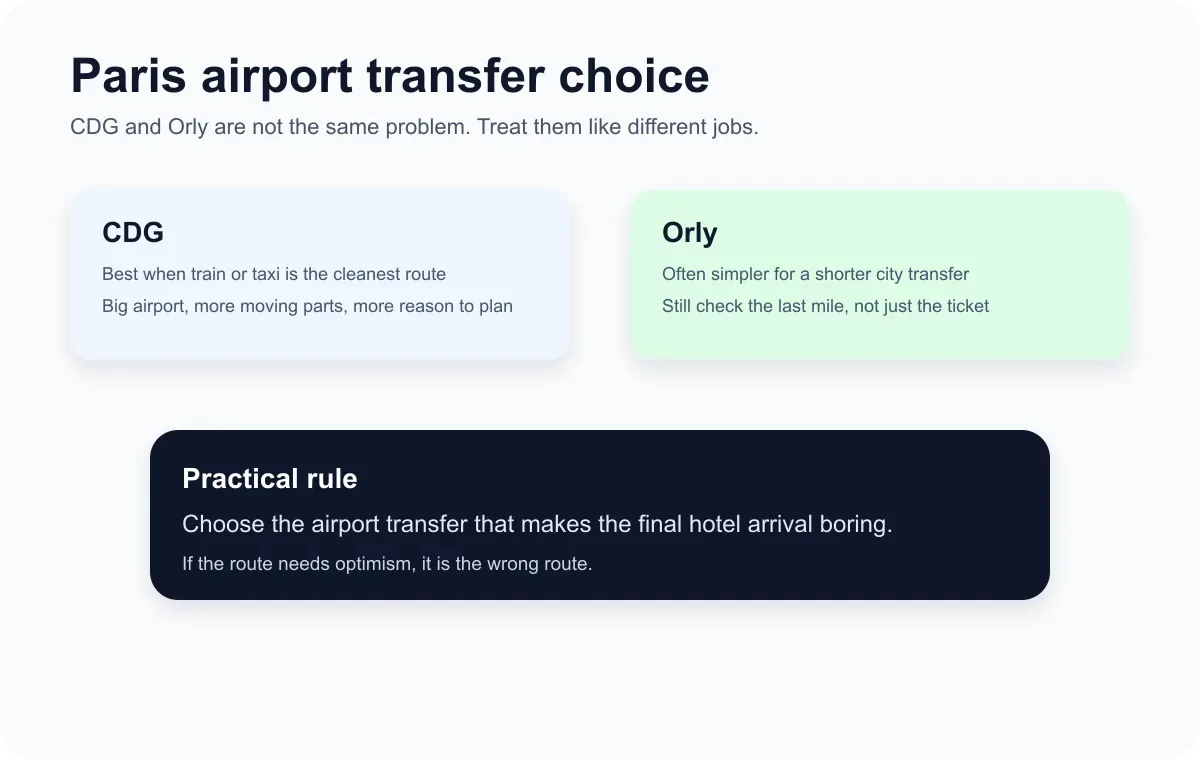
CDG is usually a RER B, taxi, or private transfer decision. Orly is usually a Metro 14, taxi, or ride-hailing decision. That simple split is the whole page in one sentence. If you remember nothing else, remember this: the easiest airport line is not always the easiest hotel arrival.
| Situation | Best default | Why |
|---|---|---|
| CDG to a hotel near Gare du Nord, Châtelet, Saint-Michel, or a direct RER B stop | RER B | Fast and cheap if you can handle stairs, platforms, and your own optimism |
| CDG with heavy bags, kids, late arrival, or a hotel that needs one more transfer | Taxi or private transfer | Fewer moving parts and less chance of ending up on the wrong platform with a bag that now feels resentful |
| Orly to central Paris with a simple route near Metro 14 | Metro 14 | Usually the cleanest rail answer if your hotel is already friendly to that line |
| Orly with luggage, family chaos, or a hotel after a long cross-town transfer | Taxi | The last mile matters more than the theory |
CDG default
If you are landing at CDG and staying in a central area with a direct rail connection, RER B can be the cleanest answer. It is usually the right choice when you are traveling light, know your station exit, and do not need to negotiate a staircase campaign with a suitcase. If any of those conditions are false, do not get cute. A taxi may be the better plan.
When hotel location changes the answer
Paris punishes vague planning. A hotel can be “central” on paper and still be annoying in real life if it is across a messy interchange, up a narrow street, or one platform change away from your patience collapsing. If your hotel is near Gare du Nord, the RER B story is different from a hotel on the Left Bank or a place near a Metro 14 stop. Choose the transfer that makes the final walk small, not the transfer that looks clever in a blog table.
Key details
Check the specific details for your trip timing and booking method. Prices, schedules, and availability change seasonally, so verify before you go.
Practical tips
Check the specific details for your trip timing and booking method. Prices, schedules, and availability change seasonally, so verify before you go.
Common questions
Check the specific details for your trip timing and booking method. Prices, schedules, and availability change seasonally, so verify before you go.
Use this rule: if the airport leg is easy but the hotel leg is awkward, the whole transfer is awkward. People keep pretending the last kilometer is optional. It is not. It is the part you remember.
When hybrid plans beat full rail or full taxi
Some Paris trips work best as a hybrid. For example, you might take rail from CDG because your hotel sits neatly on the line, then take a taxi back to the airport on departure day because your flight leaves early and you do not want to drag bags through morning crowds. That is normal. A good transfer plan does not need ideological purity.
If you are traveling with one bag and no checked lu
Common Mistakes
Double-check your plans before heading out. A small oversight here can cost you time and money.
ggage, rail is often enough. If you are traveling with two bags, a backpack, a child, and a bad mood, then the “savings” from rail can disappear fast. Use the option that reduces friction on the side of the trip that matters most.How to choose when you are tired and second-guessing everything
Here is the practical shortcut. Choose rail when all of these are true: your hotel is close to the right station, you are not exhausted, your luggage is manageable, and you have already checked the route in the daylight version of the map. Choose taxi when any of these are true: you land late, the hotel route is unclear, your luggage is heavy, your group is large, or you are already too tired to enjoy a small logistical puzzle.
Low-battery fallback: if your phone is dying, do not build a complicated rail transfer around a map you can barely open. Take the simpler option. Rail is only simple when the traveler can still think clearly enough to use it.
Late-night fallback: if you land after a long day and the arrival hall already feels like it has ideas, reduce the number of decisions. A direct taxi or pre-booked transfer is usually the least annoying answer.
Common airport transfer mistakes in Paris
Common mistake: choosing the cheapest airport line and ignoring the hotel-side walk. That is how people end up paying less and suffering more, which is not the victory some travelers think it is.
Common mistake: assuming CDG and Orly are interchangeable. They are not. The routes, lines, and effort profile are different enough that you should decide them separately.
Common mistake: forgetting that a transfer with stairs and platform changes is harder with luggage than it looks on a clean map. Maps are optimistic. Suitcases are not.
Common mistake: treating a taxi as a failure. Sometimes a taxi is the correct answer because the real goal is not “use rail.” The real goal is “reach the hotel without wasting half your energy at the airport.”
What to do if: you are still unsure after reading this, pick the option that keeps the number of transitions smallest. In Paris, fewer transitions usually beats more cleverness.
Official sources
Use these for current airport and transport details before you lock in your route:
- Paris Aéroport passenger information
- Paris Aéroport transport and parking
- CDG airport information
- Orly airport information
- SNCF Connect
- RATP official travel information
FAQ
Is RER B always the best answer from CDG?
No. It is often the best rail answer, but not always the best overall answer. If your hotel route is awkward, your luggage is heavy, or you land late, a taxi can be the smarter choice.
Is Metro 14 always the best answer from Orly?
No. It is usually the cleanest rail option when your hotel sits on a friendly route, but the final walk still matters. If the hotel side is messy, take the simpler transfer.
Should I pre-book a taxi or transfer in Paris?
If you are landing late, traveling with family, or arriving with more bags than common sense recommends, pre-booking is often worth it because it removes one airport decision after the flight.
What is the safest fallback if I am not sure?
Pick the transfer with the fewest changes between the airport and the hotel entrance. In Paris, the simplest route usually wins when you are tired.
Practical verdict: choose rail for simple, light, direct arrivals. Choose taxi for late, heavy, or unclear arrivals. The right transfer is the one that makes the hotel door feel closer, not the one that looks smartest in a vacuum.
Travel insurance is one of those things you do not need until you desperately do. A cancelled flight, lost luggage, or unexpected medical issue can turn a budget trip into an expensive disaster. Check whether your credit card already includes travel coverage before buying a separate policy.
Carry a pen for filling out immigration forms and customs declarations on the plane. The flight attendants often run out, and buying one at the airport shop costs more than it should. A pen weighs nothing and saves you from awkward borrowing.
Photocopy your passport and save it as a photo on your phone. If your passport is lost or stolen, having a copy speeds up the replacement process at the embassy. Keep the original in the hotel safe and carry the copy during day trips.
Check the local tipping culture before you arrive. Tipping norms vary enormously between countries. In some places, tipping is expected and significant. In others, it is unnecessary or even awkward. Knowing the local norm prevents uncomfortable moments at restaurants.
Common Mistakes to Avoid
Most travelers get this wrong in a few predictable ways. Double-check your route, confirm your booking details, and leave extra time during peak hours. Small mistakes here turn into big headaches fast.
Budget Breakdown
Expect to pay between the cheapest and most expensive option. The middle ground usually offers the best value. Factor in hidden fees, currency conversion, and surge pricing during rush hours.
Safety and Comfort Tips
Keep your belongings close, stay aware of your surroundings, and choose well-lit stops or stations if traveling at night. Comfort matters more than you think on longer routes.
Accessibility Notes
Most major routes are accessible, but verify wheelchair access, elevator availability, and step-free entrances before you travel. Call ahead if you need specific accommodations.
Related guides
- LAX Airport Uber Cost 2026: Pickup, Fees, Taxi Comparison
- Hotels Near CDG With Shuttle and Late Check-In 2026
- France Itinerary 10 Days in 2026: Paris + Strasbourg or Pari
- France Itinerary 7 Days in 2026: Paris Only or Paris + Stras
- Orly to Paris With Heavy Luggage 2026
- CDG to Paris With Heavy Luggage in 2026: Best Transfer, Taxi