Updated: May 2026
Budapest is good for remote work, but not every pretty cafe wants your laptop living there rent-free for six hours. The trick is knowing when you need a cafe, when you need coworking, and when you need to stop pretending one espresso buys you an office lease.
This guide is for digital nomads who need real work time: Wi-Fi, outlets, table turnover, neighborhood logic and a backup plan when every decent seat is already occupied by someone editing a spreadsheet with the intensity of a hostage negotiator.
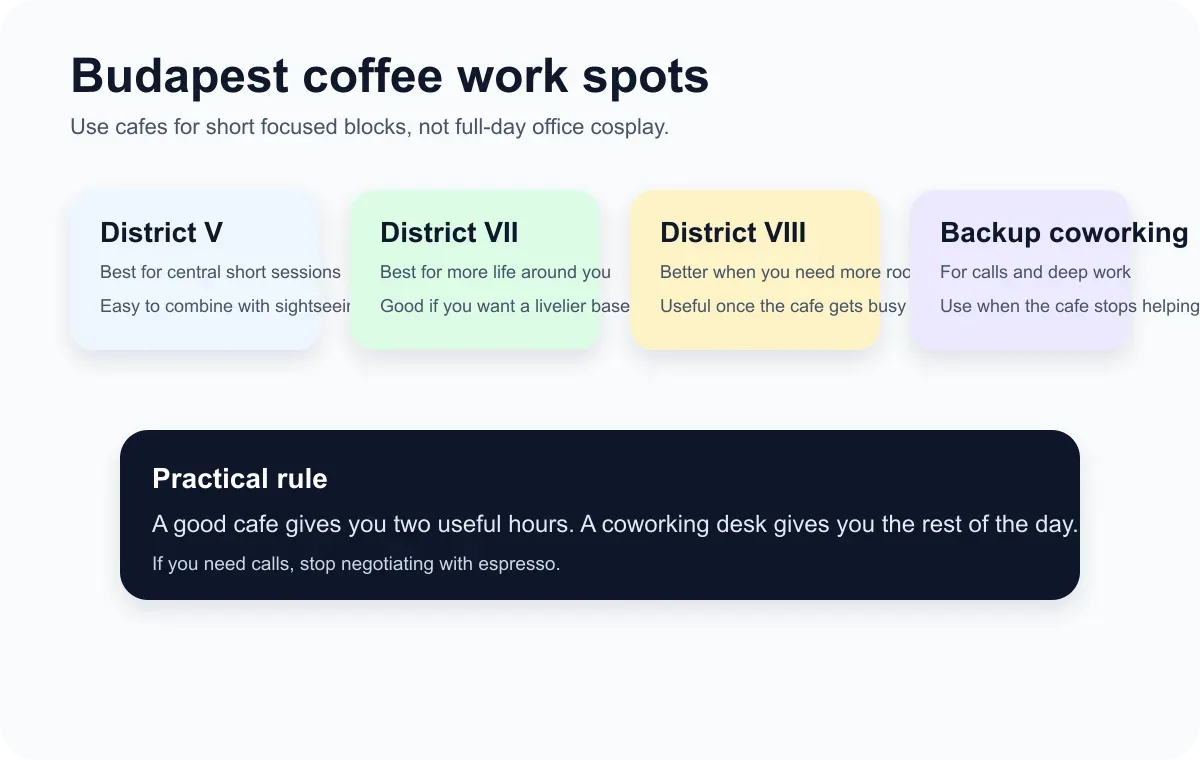
Quick answer: use cafes for two-hour work blocks, not full-day office cosplay. If you need calls or deep work, switch to coworking. District V is easiest for central short sessions, District VII is better if you want more life around you, and District VIII gives you more room once you stop pretending every cafe wants a laptop colony.
First decision: cafe work or coworking?
Use cafes for two-hour sessions, email, writing, planning and light calls. Use coworking for long calls, deep work, client meetings or anything involving headphones and your serious face.
Key details
Check the specific details for your trip timing and booking method. Prices, schedules, and availability change seasonally, so verify before you go.
Practical tips
Check the specific details for your trip timing and booking method. Prices, schedules, and availability change seasonally, so verify before you go.
Best default: base yourself near District V, VI, VII, VIII or XIII depending on your budget and vibe, then keep a shortlist of three cafes plus one coworking backup.
Common mistake: relying on one famous cafe. If it is full, noisy or laptop-hostile that day, your productivity plan collapses into walking with a laptop and a wounded expression.
Madal Cafe: calm, central and good for focused work
Madal is a good first stop because it feels calm, has serious coffee and works well for writing or admin. It is not the place for loud calls. Nobody needs your Q3 strategy echoing across the oat milk.
Best for: solo work, planning days, early starts and shorter deep-work blocks. Watch out for peak hours when tables turn quickly and outlet seats disappear.
What to do if it is full: switch to a nearby branch or move the serious work to coworking and come back later for coffee that does not have deadlines attached.
Espresso Embassy: best for short work near central sights
Espresso Embassy is useful if you are central and need a polished coffee stop between errands or meetings. It is better for a focused hour than a full-day laptop camp.
Best for: quick email blocks, meeting a client, or resetting between sightseeing and work. If you are staying near the Basilica or Deak Ferenc ter, it is practical.
Watch out: central location means it can get busy. If your work needs silence, do not fight the room. Find a coworking desk before your patience starts buffering.
Flow Specialty Coffee: better when you also need food
Flow is useful because it combines coffee, food and a laptop-friendly feel. That matters when a work block crosses lunch and your entire plan cannot be held together by one pastry.
Best for: midday work, vegetarian food, and nomads who need a proper meal without leaving their laptop unattended. Watch out for lunch rush and table pressure.
Common mistake: choosing a cafe only for coffee. If you need three hours, check food, seating and noise too. Caffeine is not a project-management system.
Neighborhood strategy: where to stay if cafes matter
District V is central but pricier and busier. District VI and VII give more cafe density and nightlife. District XIII can be calmer and more residential. District VIII has improving cafe options but varies block by block.
Best default: stay within easy tram or metro reach of your work zones. Budapest is manageable, but crossing town twice a day gets old fast.
For broader city planning, pair this with our Central Europe city guide and digital nomad hotspots guide.
Practical verdict
If you need only one takeaway: use cafes for short work blocks, then move to coworking before the chair becomes a personality trait. District V is the easiest starting point, District VII has more energy, and District VIII buys you breathing room when the laptop and the people around you both get tired. The point is not to claim a cafe as an office. The point is to get the work done without annoying the cafe staff or yourself.
Use Budapest cafes for short, focused sessions and coworking for work that actually pays rent. Madal and Espresso Embassy are strong central options, Fekete is good when the courtyard mood works, and Flow helps when you need food with your work block.
Sam's take: buy properly, tip normally, do not camp at a tiny table through lunch, and always have a backup. The cafe owes you coffee. It does not owe you a branch office.
A realistic Budapest workday
Start with a cafe before lunch for writing, email or planning. Move before the lunch rush if the room fills up. Use the afternoon for coworking, calls or anything that needs a guaranteed seat. Then keep the evening free for the city, because Budapest after dark is better than pretending to work badly from a noisy table.
If your phone battery is low, save your accommodation address and coworking address offline before leaving. Budapest public transport is useful, but your brain becomes less useful when you are tired, hungry and trying to pronounce a street name with six consonants in a trench coat.
FAQ
Can you work from cafes in Budapest?
Yes, but use cafes for shorter sessions and coworking for long calls or full workdays.
Which Budapest district is best for digital nomads?
Districts V, VI, VII, VIII and XIII can work, depending on budget, nightlife tolerance and coworking needs.
Do Budapest cafes usually have outlets?
Some do, but do not rely on it. Charge before leaving and keep a coworking backup for long sessions.
When to leave the cafe
The polite Budapest cafe rule is simple: if the room is full, your table is small, or lunch service has started, move on. A laptop is not a diplomatic passport. Use cafes for short work blocks, then switch to coworking or your apartment for calls and deep work.
If you need one reliable workday, plan two cafes and one coworking backup before leaving your room. That way a full cafe becomes a minor inconvenience, not the reason your afternoon collapses into wandering with a laptop and bad posture.
Cafe etiquette that keeps the scene usable
Remote workers can quietly ruin good cafes by treating them like free coworking spaces. Buy more than one drink if you stay, avoid video calls in small rooms, and move during meal rushes. This is not just politeness. It keeps laptop-friendly cafes from becoming laptop-hostile cafes.
If you need privacy, book coworking. If you need atmosphere, use a cafe. If you need six hours, five calls and a charger, you need an office, not a cappuccino with delusions of infrastructure.
Sources and further reading
Use the official Budapest sources to check districts and planning context before you settle on a remote-work base.
- Budapestinfo - official city information.
- Budapest districts - neighborhood context.
- Budapest what to do - general city planning.
Travel insurance is one of those things you do not need until you desperately do. A cancelled flight, lost luggage, or unexpected medical issue can turn a budget trip into an expensive disaster. Check whether your credit card already includes travel coverage before buying a separate policy.
Carry a pen for filling out immigration forms and customs declarations on the plane. The flight attendants often run out, and buying one at the airport shop costs more than it should. A pen weighs nothing and saves you from awkward borrowing.
Photocopy your passport and save it as a photo on your phone. If your passport is lost or stolen, having a copy speeds up the replacement process at the embassy. Keep the original in the hotel safe and carry the copy during day trips.
Check the local tipping culture before you arrive. Tipping norms vary enormously between countries. In some places, tipping is expected and significant. In others, it is unnecessary or even awkward. Knowing the local norm prevents uncomfortable moments at restaurants.
Download a translation app that works offline. Google Translate and similar apps can translate text, voice, and even camera images without an internet connection. Download the language pack for your destination before you leave home Wi-Fi.
Bring a reusable water bottle. It saves money, reduces plastic waste, and ensures you stay hydrated during long walking days. Many cities have public water fountains that are safe to drink from. Fill up before heading out each morning.
Travel insurance is one of those things you do not need until you desperately do. A cancelled flight, lost luggage, or unexpected medical issue can turn a budget trip into an expensive disaster. Check whether your credit card already includes travel coverage before buying a separate policy.
Carry a pen for filling out immigration forms and customs declarations on the plane. The flight attendants often run out, and buying one at the airport shop costs more than it should. A pen weighs nothing and saves you from awkward borrowing.
Photocopy your passport and save it as a photo on your phone. If your passport is lost or stolen, having a copy speeds up the replacement process at the embassy. Keep the original in the hotel safe and carry the copy during day trips.
Check the local tipping culture before you arrive. Tipping norms vary enormously between countries. In some places, tipping is expected and significant. In others, it is unnecessary or even awkward. Knowing the local norm prevents uncomfortable moments at restaurants.
Download a translation app that works offline. Google Translate and similar apps can translate text, voice, and even camera images without an internet connection. Download the language pack for your destination before you leave home Wi-Fi.
Bring a reusable water bottle. It saves money, reduces plastic waste, and ensures you stay hydrated during long walking days. Many cities have public water fountains that are safe to drink from. Fill up before heading out each morning.