Updated: April 2026
Cologne looks deceptively simple because the station is beside the Cathedral. The real hotel decision is whether the chosen area protects late arrival, sleep, breakfast, luggage, and the correct morning entrance to the station.
This is a practical hotel-area guide for travelers who care about the next train more than abstract neighborhood charm. It explains when to stay right by Köln Hbf, when to choose a nearby district, and when a slightly nicer area creates too much morning friction.
Quick answer
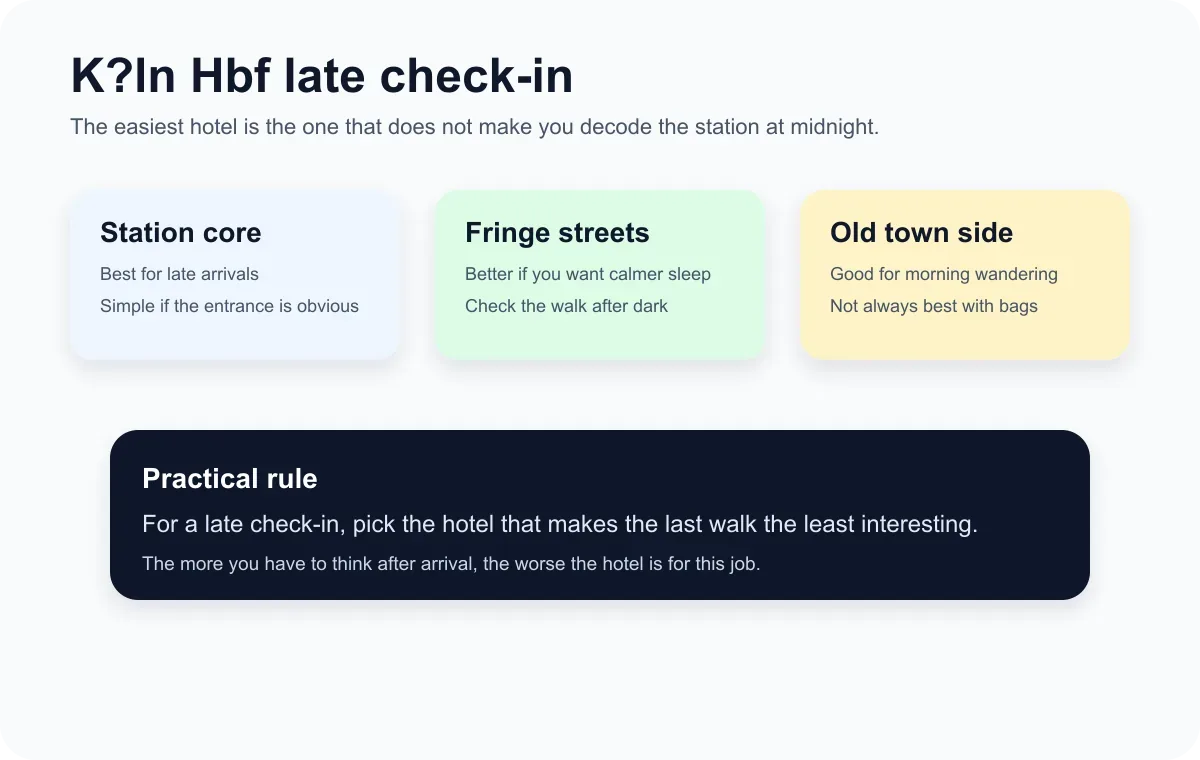
Stay near Köln Hbf, the Dom side, or a clean Altstadt route when the early train controls the trip; choose Deutz or a tram-linked neighborhood only when the morning crossing and luggage plan are still reliable. If you want one polished Cathedral-side example, Excelsior Hotel Ernst Cologne is the clearest fit.
Key details
Table of contents
- How the station-area decision works
- Best areas for early trains
- Late arrival and first-night comfort
- Luggage, breakfast, and checkout
- When not to stay closest
- Hotel checks before booking
- Area-by-area decision notes
- Source check
- FAQ
How the station-area decision works
Köln Hbf sits beside the Cathedral and connects long-distance rail, regional rail, S-Bahn, and local KVB/VRS movement. Its centrality is useful, but the river side, station exit, crowding, and exact hotel approach decide whether a stay feels easy.
Read reviews for operations, not adjectives
For Köln Hbf hotels, the best reviews are operational. Look for late check-in, noise, elevator, breakfast timing, room size, air-conditioning or heating, luggage storage, and staff behavior when something goes wrong.
The two-night rule
For one night, prioritize logistics. For two or more nights, you can justify a better neighborhood if the station route remains reliable. This rule prevents travelers from overvaluing charm on a trip where the hotel is mostly a sleep-and-depart tool.
Event and peak-date pressure
Cologne can become much harder during events, holidays, trade fairs, school breaks, or major weekends. Prices rise, good rooms disappear, taxis get busier, and station-area compromises become more expensive.
The practical verdict
Choose the option that still works when the trip is ordinary rather than perfect. Ordinary means a delay, rain, heavy bags, tired people, a crowded station, or a room that needs a quick check-in conversation.
The best Köln Hbf plan is not the most impressive. It is the one that protects arrival, sleep, and the next fixed move with the fewest weak links.
If two choices look similar, pick the one you can explain to a tired traveler in one sentence. That is usually the better travel decision.
Detailed station-hotel decision playbook
Platform buffer: Build the hotel choice around a real platform buffer, not a perfect checkout. A traveler leaving Köln Hbf early needs time for elevator waits, station crowds, unclear platforms, coffee, bathrooms, and the small pause that happens when people recheck tickets. The closer hotel is only better if it protects that buffer without damaging sleep.
Traveler casebook for choosing the right stay
The delayed intercity arrival: If the inbound train reaches Köln Hbf later than planned, the hotel plan should shrink immediately. Skip the scenic route, ignore the marginally cheaper tram option, and choose the route that gets everyone inside cleanly. Delays also change food planning because restaurants and shops may close before the group is ready. A strong hotel choice has a late-arrival path that still works without a long discussion at the station.
The early international connection: When the next morning involves an international train or airport connection, the hotel should protect document checks, platform uncertainty, and extra buffer. Do not book a charming district that requires a fragile first train unless the schedule has room for failure. The safer choice is a hotel that lets the traveler reach Köln Hbf early enough to find the platform, buy water, and absorb one small surprise.
The family with one exhausted child: Families should plan around the most tired child, not the most capable adult. A route that adults can walk easily may become slow if one child is melting down or a stroller needs lifting. The best station hotel for families keeps the evening short, breakfast predictable, and the morning route clear enough that adults are not negotiating every step while carrying bags.
The couple arriving for a short break: Couples often want atmosphere, but a short station-controlled stay still needs logistics first. Choose a pleasant area only if it preserves the arrival and departure route. The right compromise is often a hotel on a clean central edge rather than the most romantic district. That gives enough evening character without turning the morning into a transit puzzle.
The solo traveler after dark: Solo travelers should privilege clarity after dark. That means an obvious exit, a route with active streets, a hotel entrance that is easy to identify, and a backup ride option if the area feels wrong. A solo traveler can move faster than a group, but also has less margin if the route becomes uncomfortable or the phone battery drops.
The business traveler with a morning meeting: A business traveler should treat the hotel as part of the meeting plan. Sleep, shower timing, breakfast, desk space, and transport to the appointment matter more than sightseeing access. If the meeting follows an early train, choose the hotel that reduces morning decisions. If the meeting is elsewhere in Cologne, confirm the route from the hotel before choosing the station area by default.
The traveler with mobility limits: Mobility needs make station proximity less useful unless the route is actually accessible. Check elevators, curb cuts, station levels, hotel entrance steps, and whether taxi can drop close to the door. A hotel that is technically near Köln Hbf but awkward at the entrance can be worse than a farther hotel with direct taxi access and a reliable lift.
The one-night stopover: For one night, the hotel should be judged like infrastructure. It needs to receive you, let you sleep, and release you back to Köln Hbf without drama. Do not optimize for amenities you will not use. A rooftop bar or spa means little if the room is noisy, breakfast opens late, or the morning route is awkward with bags.
The traveler arriving with children asleep: If children may arrive asleep, avoid any plan that requires multiple decisions after leaving the train. A close hotel with elevator access, a clear entrance, and a short food or bedtime path is worth more than a prettier neighborhood. Carrying a sleeping child while dragging bags makes every extra crossing feel longer than the map promised.
The traveler with morning tickets already booked: Fixed train tickets increase the cost of a slow morning. The hotel should leave enough time for checkout, platform discovery, coffee, and one small mistake. If the ticket is nonrefundable or the onward route is important, choose the hotel that makes missing the train unlikely rather than the one that makes the evening slightly more interesting.
The traveler using public transport passes: A visitor pass can make farther neighborhoods feel easy, but only if service frequency and walking distance work at the exact travel time. Do not let a valid ticket hide a weak first or last segment. The pass reduces fare friction; it does not remove stairs, waits, weather, or the need to find the right exit.
The traveler choosing between station sides: When choosing between station sides, compare the evening and the morning separately. One side may be better for dinner while the other is better for departure. If the stay is short, the morning usually wins. If the stay is longer, choose the side that gives the best total rhythm without making Köln Hbf hard to reach.
The traveler who hates rushing: If rushing ruins the trip for you, pay for the calmer logistics. That may mean a closer hotel, a quieter room, flexible cancellation, or a taxi fallback. The cheapest acceptable plan is not always the best personal plan. Some travelers get more value from reducing uncertainty than from saving a modest amount on the room.
The traveler making the final booking decision: Before booking, read the plan out loud as a sequence: arrive at Köln Hbf, leave by the correct side, reach the hotel, check in, sleep, eat or get coffee, check out, and return to the platform. If any step sounds vague, fix that step before paying. A station hotel is successful when the whole sequence feels boring enough to trust, even after a normal delay, ordinary bad weather, and a tired traveler who no longer wants to compare alternatives.
Source check
This guide was grounded against current official or primary transport sources where the operating details matter. Always recheck live signs, fares, station works, app pickup instructions, and service alerts close to travel, because terminal routing, public-transport service, taxi rules, construction, and hotel procedures can change faster than a saved guide. The page explains the decision logic, while the linked official sources should control final same-day details. If official signage, hotel instructions, or transport alerts disagree with this guide, follow the live operating source and use the article as the decision framework rather than as a replacement for current rules.
FAQ
Where should I stay in Cologne for an early train?
For the easiest morning, stay near Köln Hbf or on a direct Dom/Altstadt route. Deutz and tram-linked areas can work, but only if the river crossing or local connection is realistic with bags.
Is the area around Köln Hbf good for one night?
Yes, when the hotel has a clear route, good reviews for noise and reception, and a simple morning return. Do not choose only by distance because station-edge streets and crowd flow vary.
Is Deutz a good alternative for early trains?
Deutz can be practical for some rail plans and quieter stays, but it adds river-side logic. It works best when the departure station, bridge/taxi route, and luggage plan are already clear.
How close should my Cologne hotel be to the station?
Close enough that the platform return is predictable. A calm 8- to 12-minute route can be better than a shorter route through crowds or confusing station exits.