Updated: April 2026
Köln Hbf is extremely central, which makes the arrival look easier than it always feels. The mistake is assuming every hotel near the Cathedral or river is equally simple after a train, with luggage, crowds, and the wrong exit in play.
This guide gives a practical arrival plan for Köln Hbf: when to use walking, when KVB tram or Stadtbahn is worth it, when taxi is the sensible fallback, and how to avoid turning the station exit into the hardest part of the first hour.
Quick answer
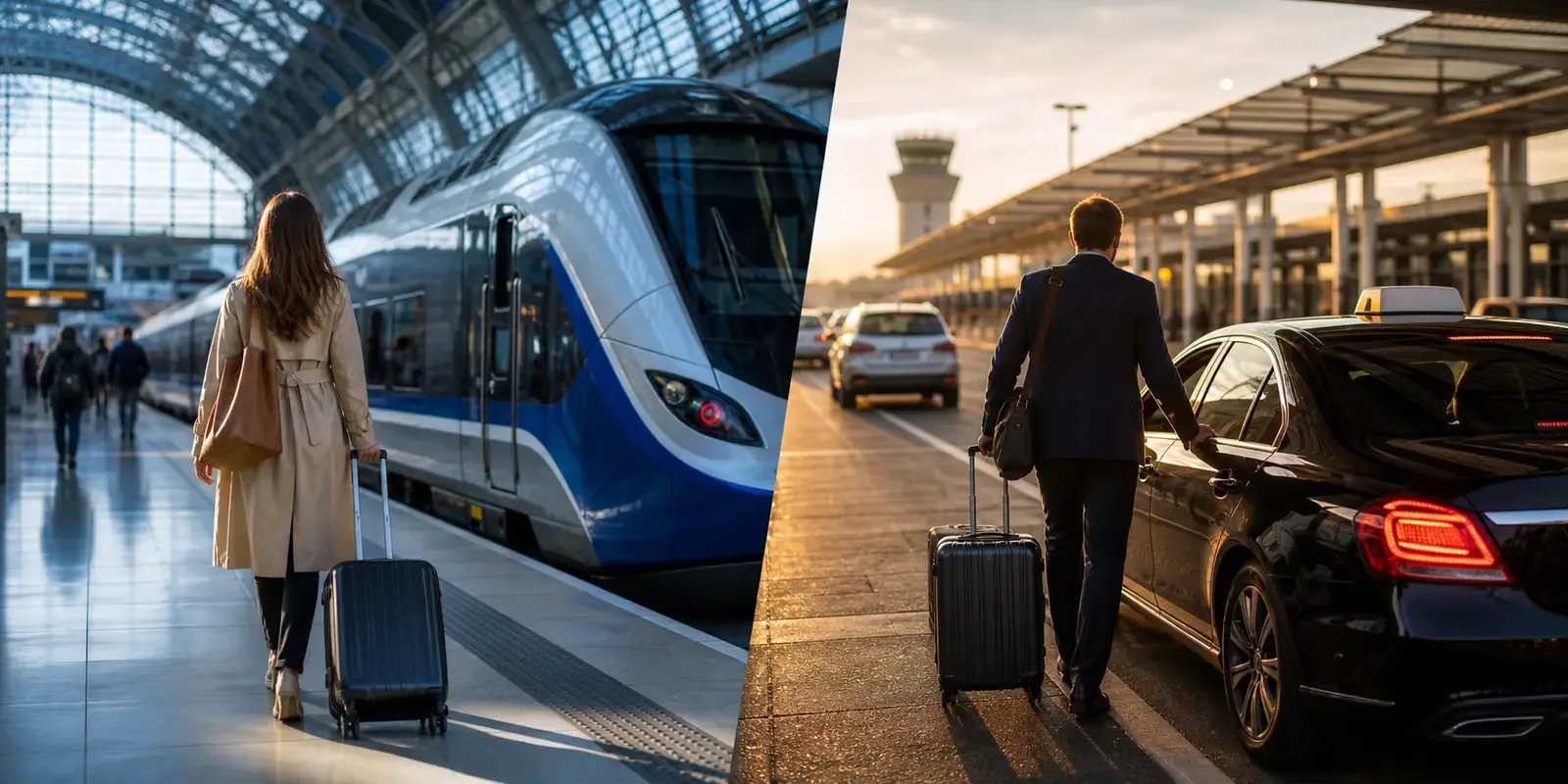
Walk when your hotel is on a direct Dom or Altstadt route and bags are manageable; use tram or Stadtbahn when it removes a real cross-city segment; take taxi when late timing, rain, heavy luggage, Deutz routing, or station-edge confusion makes the last mile weak.
Key details
Table of contents
- Start with the hotel door
- When walking is strongest
- When local transit is worth it
- When taxi is the smart call
- Late arrival and luggage logic
- Station exits and wrong-side risk
- Traveler casebook
- Source check
- FAQ
Start with the hotel door
Start with the hotel door matters because Köln Hbf is extremely central, which makes the arrival look easier than it always feels. The mistake is assuming every hotel near the Cathedral or river is equally simple after a train, with luggage, crowds, and the wrong exit in play. The practical choice is controlled by the exact route, the real travel hour, and the traveler’s tolerance for small failures. Around the Dom side, Breslauer Platz, Altstadt, the Rhine, Deutz, Neumarkt, Belgian Quarter, and tram-linked hotel pockets, a plan that looks simple online can become weaker when bags, crowds, weather, or timing are added.
When walking is strongest
When walking is strongest matters because Köln Hbf is extremely central, which makes the arrival look easier than it always feels. The mistake is assuming every hotel near the Cathedral or river is equally simple after a train, with luggage, crowds, and the wrong exit in play. The practical choice is controlled by the exact route, the real travel hour, and the traveler’s tolerance for small failures. Around the Dom side, Breslauer Platz, Altstadt, the Rhine, Deutz, Neumarkt, Belgian Quarter, and tram-linked hotel pockets, a plan that looks simple online can become weaker when bags, crowds, weather, or timing are added.
When local transit is worth it
When local transit is worth it matters because Köln Hbf is extremely central, which makes the arrival look easier than it always feels. The mistake is assuming every hotel near the Cathedral or river is equally simple after a train, with luggage, crowds, and the wrong exit in play. The practical choice is controlled by the exact route, the real travel hour, and the traveler’s tolerance for small failures. Around the Dom side, Breslauer Platz, Altstadt, the Rhine, Deutz, Neumarkt, Belgian Quarter, and tram-linked hotel pockets, a plan that looks simple online can become weaker when bags, crowds, weather, or timing are added.
When taxi is the smart call
When taxi is the smart call matters because Köln Hbf is extremely central, which makes the arrival look easier than it always feels. The mistake is assuming every hotel near the Cathedral or river is equally simple after a train, with luggage, crowds, and the wrong exit in play. The practical choice is controlled by the exact route, the real travel hour, and the traveler’s tolerance for small failures. Around the Dom side, Breslauer Platz, Altstadt, the Rhine, Deutz, Neumarkt, Belgian Quarter, and tram-linked hotel pockets, a plan that looks simple online can become weaker when bags, crowds, weather, or timing are added.
Late arrival and luggage logic
Late arrival and luggage logic matters because Köln Hbf is extremely central, which makes the arrival look easier than it always feels. The mistake is assuming every hotel near the Cathedral or river is equally simple after a train, with luggage, crowds, and the wrong exit in play. The practical choice is controlled by the exact route, the real travel hour, and the traveler’s tolerance for small failures. Around the Dom side, Breslauer Platz, Altstadt, the Rhine, Deutz, Neumarkt, Belgian Quarter, and tram-linked hotel pockets, a plan that looks simple online can become weaker when bags, crowds, weather, or timing are added.
Station exits and wrong-side risk
Station exits and wrong-side risk matters because Köln Hbf is extremely central, which makes the arrival look easier than it always feels. The mistake is assuming every hotel near the Cathedral or river is equally simple after a train, with luggage, crowds, and the wrong exit in play. The practical choice is controlled by the exact route, the real travel hour, and the traveler’s tolerance for small failures. Around the Dom side, Breslauer Platz, Altstadt, the Rhine, Deutz, Neumarkt, Belgian Quarter, and tram-linked hotel pockets, a plan that looks simple online can become weaker when bags, crowds, weather, or timing are added.
Traveler casebook
Traveler scenario: If the hotel is on the obvious side of Köln Hbf, walking can be the best move. The route should have a clear first turn, reasonable lighting, and no complicated crossing sequence. The specific test is whether the choice still works with normal friction: delayed arrival, heavier-than-expected bags, a tired traveler, unclear signage, weather, and a next fixed point that cannot move. If the plan depends on perfect conditions, choose the calmer backup before the trip starts.
Traveler scenario: If the hotel is beyond the comfortable luggage radius, KVB tram or Stadtbahn can help only when the stop is close to the hotel door. A short ride with a long final walk is often not an improvement. The specific test is whether the choice still works with normal friction: delayed arrival, heavier-than-expected bags, a tired traveler, unclear signage, weather, and a next fixed point that cannot move. If the plan depends on perfect conditions, choose the calmer backup before the trip starts.
Traveler scenario: If the hotel is beyond the comfortable luggage radius, KVB tram or Stadtbahn can help only when the stop is close to the hotel door. A short ride with a long final walk is often not an improvement. The specific test is whether the choice still works with normal friction: delayed arrival, heavier-than-expected bags, a tired traveler, unclear signage, weather, and a next fixed point that cannot move. If the plan depends on perfect conditions, choose the calmer backup before the trip starts.
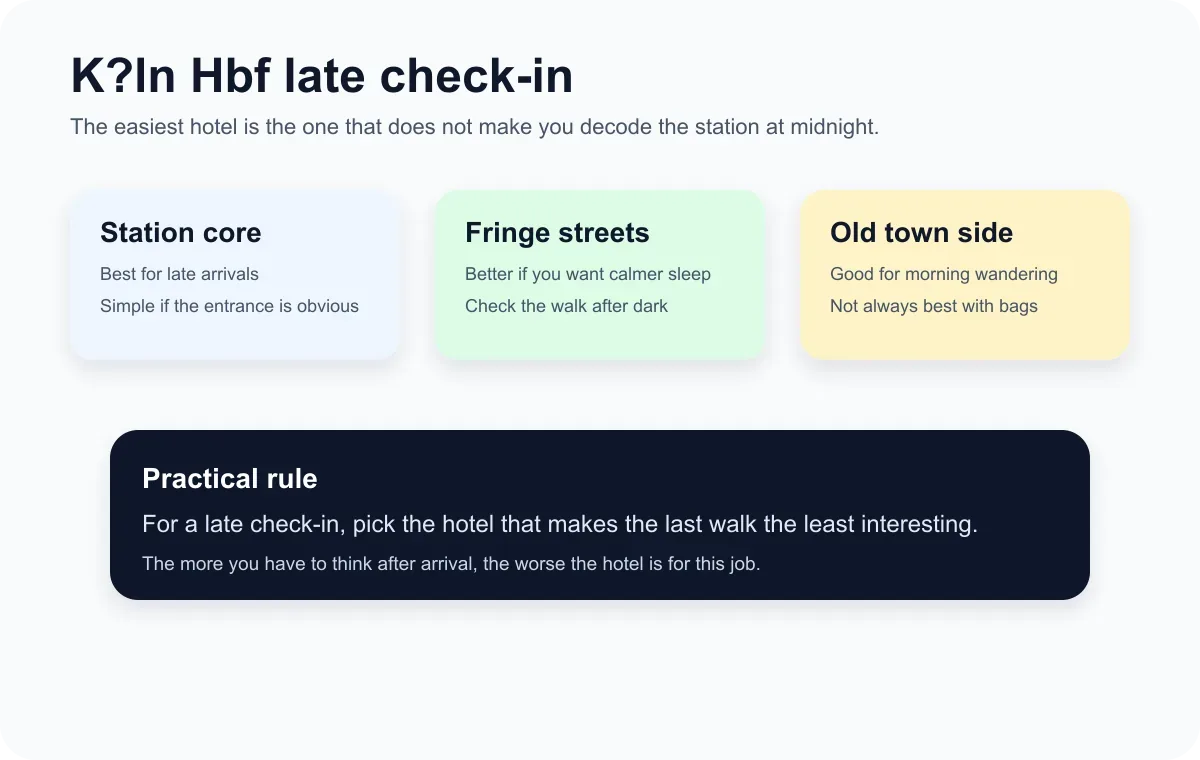
Traveler scenario: If the train arrives late, simplify immediately. Use taxi if the route is wet, unclear, or tiring. The goal is to protect check-in and sleep, not to prove the map route works. The specific test is whether the choice still works with normal friction: delayed arrival, heavier-than-expected bags, a tired traveler, unclear signage, weather, and a next fixed point that cannot move. If the plan depends on perfect conditions, choose the calmer backup before the trip starts.
Traveler scenario: If the hotel is on the obvious side of Köln Hbf, walking can be the best move. The route should have a clear first turn, reasonable lighting, and no complicated crossing sequence. The specific test is whether the choice still works with normal friction: delayed arrival, heavier-than-expected bags, a tired traveler, unclear signage, weather, and a next fixed point that cannot move. If the plan depends on perfect conditions, choose the calmer backup before the trip starts.
Traveler scenario: If the hotel is beyond the comfortable luggage radius, KVB tram or Stadtbahn can help only when the stop is close to the hotel door. A short ride with a long final walk is often not an improvement. The specific test is whether the choice still works with normal friction: delayed arrival, heavier-than-expected bags, a tired traveler, unclear signage, weather, and a next fixed point that cannot move. If the plan depends on perfect conditions, choose the calmer backup before the trip starts.
Traveler scenario: If the train arrives late, simplify immediately. Use taxi if the route is wet, unclear, or tiring. The goal is to protect check-in and sleep, not to prove the map route works. The specific test is whether the choice still works with normal friction: delayed arrival, heavier-than-expected bags, a tired traveler, unclear signage, weather, and a next fixed point that cannot move. If the plan depends on perfect conditions, choose the calmer backup before the trip starts.
Traveler scenario: If the traveler is comparing two hotels, choose the one with the simpler route from Köln Hbf. Better arrival logistics often matter more than a small room-style difference. The specific test is whether the choice still works with normal friction: delayed arrival, heavier-than-expected bags, a tired traveler, unclear signage, weather, and a next fixed point that cannot move. If the plan depends on perfect conditions, choose the calmer backup before the trip starts.
Source check
This guide was grounded against current official or primary transport sources where operating details matter. Recheck live signs, fares, station works, app pickup instructions, timetable changes, and service alerts close to travel. If official signage, hotel instructions, rail alerts, or airport rules disagree with this guide, follow the live source and use this page as the decision framework. The article is intentionally practical rather than authoritative on live operations: official operators control same-day rules, while this guide helps you choose the calmer option when those details are known.
FAQ
Should I walk from Köln Hbf to my hotel?
Walk if the route is direct, the hotel side is clear, luggage is manageable, and arrival timing feels comfortable. Do not walk only because the map says the distance is short.
When is KVB tram or Stadtbahn worth it?
KVB tram or Stadtbahn is worth it when it removes a real distance or awkward crossing. It is weaker when the ride is short but finding the platform, ticket, and exit adds more friction than walking.
When should I take a taxi from Köln Hbf?
Take taxi when the route is late, wet, luggage-heavy, unclear, or uncomfortable. The purpose is to protect the arrival, not to cover a specific minimum distance.
What is the biggest mistake?
The biggest mistake is choosing by distance alone. The exact station exit, hotel side, group energy, weather, and luggage decide whether the transfer feels easy.