Short answer: For a first Baku stay, choose Icherisheher/Old City or the central Boulevard and Fountain Square side unless business, a rail connection, or an early flight gives another area a clear job.
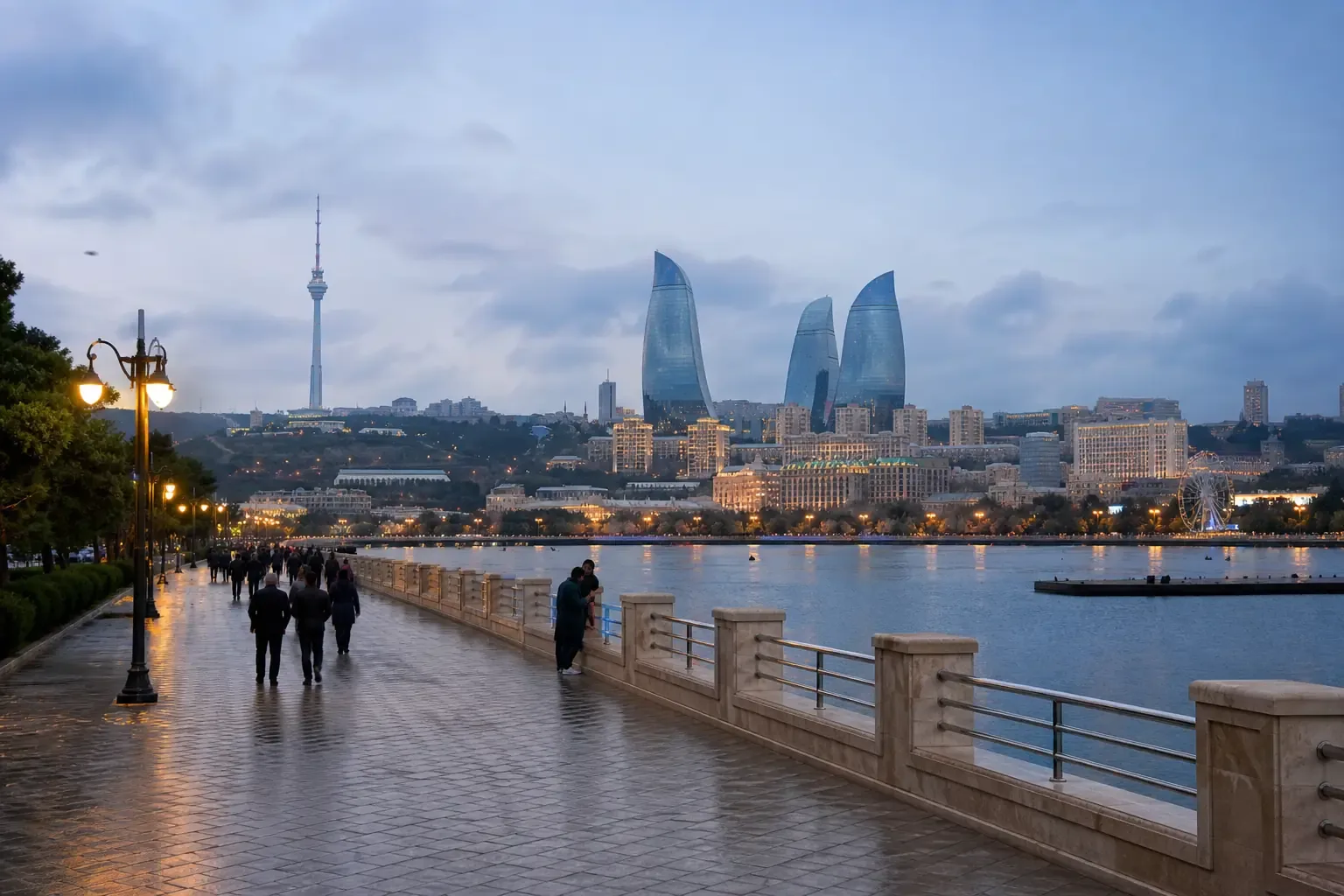
Wide boulevards, wind off the Caspian, stone streets, metro exits, and the final hotel entrance matter more than a generic “central” label. Choose the area first. Then check the route, the entrance, and the room conditions. The airport transfer is important, but it should not decide the whole hotel booking unless your flight schedule gives it veto power.
Common mistake: booking the cheapest room with a “central” label without checking the exact street and the last 300 metres.
Low-battery fallback: save the hotel address, arrival instructions, and a screenshot of the map before leaving the airport or station.
Choose the district before the hotel
A hotel search result can make every area look equally central. They are not. The decision is whether you want sightseeing outside the door, a quieter night, a useful transport connection, a ferry or business base, or the easiest early departure. Those are different jobs and should not be hidden inside one generic “best area” list.
| Trip priority | Start comparing | Check before booking |
|---|---|---|
| Icherisheher and Old City edge | Best for heritage-focused first visits, medieval streets, museums, monuments, galleries, and historic atmosphere. Check cobbles, vehicle access, and the exact entrance. | |
| Fountain Square and Nizami side | A lively central choice for restaurants, shopping, and evening access. Compare noise, pavement, and the route back to the hotel. | |
| Boulevard and modern seafront | Good for Caspian waterfront walks, newer city life, and a more open setting. Check the distance back to the Old City and the final road crossings. | |
| 28 May and central station side | Practical for Aero Express, rail, and onward travel. Check the hotel’s final leg because the airport bus terminates at the railway station/28 May area. | |
| White City | A newer, quieter seafront-oriented choice for a specific hotel or business purpose. It is not automatically the easiest base for historic sightseeing. | |
| Airport-side hotels | Choose this for an early flight or short stop. The airport lists Aero Express and official taxi information; verify current frequency, payment, and final-leg details before relying on it. |
What the current arrival sources actually confirm
The official Heydar Aliyev International Airport source is the place to recheck current airport transport, taxi, ticket, and service details. The operator or city transport source should be used for active routes, fares, stops, and payment instructions. Do not copy an old timetable into a hotel guide and call it planning.
Where the official page is dynamic, blocked, or only shows a selector, keep the advice narrow: check the live page for the current service, then choose the hotel whose final walk remains manageable if the cheapest connection is late, full, cancelled, or simply not worth the handoff with luggage.
Area-by-area booking notes
Icherisheher and Old City edge: Best for heritage-focused first visits, medieval streets, museums, monuments, galleries, and historic atmosphere. Check cobbles, vehicle access, and the exact entrance. This is the sort of detail worth checking in the booking map, because a district label can cover a much less convenient street edge. Before paying, open the exact hotel address, inspect the route from the likely arrival point, and check reception, luggage storage, and late-arrival instructions. If the final walk is uphill, cobbled, exposed, or poorly lit, treat that as part of the room price.
Fountain Square and Nizami side: A lively central choice for restaurants, shopping, and evening access. Compare noise, pavement, and the route back to the hotel. This is the sort of detail worth checking in the booking map, because a district label can cover a much less convenient street edge. Before paying, open the exact hotel address, inspect the route from the likely arrival point, and check reception, luggage storage, and late-arrival instructions. If the final walk is uphill, cobbled, exposed, or poorly lit, treat that as part of the room price.
Boulevard and modern seafront: Good for Caspian waterfront walks, newer city life, and a more open setting. Check the distance back to the Old City and the final road crossings. This is the sort of detail worth checking in the booking map, because a district label can cover a much less convenient street edge. Before paying, open the exact hotel address, inspect the route from the likely arrival point, and check reception, luggage storage, and late-arrival instructions. If the final walk is uphill, cobbled, exposed, or poorly lit, treat that as part of the room price.
28 May and central station side: Practical for Aero Express, rail, and onward travel. Check the hotel’s final leg because the airport bus terminates at the railway station/28 May area. This is the sort of detail worth checking in the booking map, because a district label can cover a much less convenient street edge. Before paying, open the exact hotel address, inspect the route from the likely arrival point, and check reception, luggage storage, and late-arrival instructions. If the final walk is uphill, cobbled, exposed, or poorly lit, treat that as part of the room price.
White City: A newer, quieter seafront-oriented choice for a specific hotel or business purpose. It is not automatically the easiest base for historic sightseeing. This is the sort of detail worth checking in the booking map, because a district label can cover a much less convenient street edge. Before paying, open the exact hotel address, inspect the route from the likely arrival point, and check reception, luggage storage, and late-arrival instructions. If the final walk is uphill, cobbled, exposed, or poorly lit, treat that as part of the room price.
Airport-side hotels: Choose this for an early flight or short stop. The airport lists Aero Express and official taxi information; verify current frequency, payment, and final-leg details before relying on it. This is the sort of detail worth checking in the booking map, because a district label can cover a much less convenient street edge. Before paying, open the exact hotel address, inspect the route from the likely arrival point, and check reception, luggage storage, and late-arrival instructions. If the final walk is uphill, cobbled, exposed, or poorly lit, treat that as part of the room price.
When an airport hotel is actually the right choice
It is the right choice when the flight time, weather, or late landing makes a city transfer a needless risk. Confirm the route, desk hours, and morning departure before paying.
Choose the airport area for an early departure, a very late arrival, a short work stop, or a deliberate buffer before a flight. Do not choose it by accident because the booking page calls it “convenient.” Compare the first departure you need, the hotel’s reception and shuttle terms, the cost of getting into the city, and whether you will spend the whole stay commuting back to the sights.
Late arrival changes the answer
At night, choose the area and property with the clearest door and simplest transfer. Confirm the key procedure and contact before travelling. A beautiful location is less useful if no one can let you in.
After midnight, the cheapest route may be slower, emptier, or no longer running. If the next connection is uncertain and the hotel is not directly beside the arrival point, use the official taxi rank or a confirmed hotel transfer. This is not a failure of travel personality. It is the adult decision when your phone is at 9 percent and the suitcase wheel has started making a noise.
Families, heavy luggage, and mobility
Count slopes, stairs, crossings, shelter, and the hotel entrance. A short map distance can be unsuitable for a child, mobility aid, or several bags. Choose the route you can actually complete.
A solo traveller with a backpack can tolerate one extra change. A family, wheelchair user, or traveller with several bags experiences the same district differently. Check lift access, slopes, cobbles, snow or rain exposure, the number of crossings, and whether a vehicle can stop close to the entrance. Ask the property directly when the listing is vague.
Hotel booking checks that prevent expensive regret
Check the exact address, cancellation terms, reception, entrance, transport, and final walk. A room is not good value if its arrival depends on an uncertain connection or unanswered phone.
- Confirm the exact address and entrance, not only the neighbourhood name.
- Check reception hours and the late-arrival process.
- Check whether luggage storage is available before check-in and after check-out.
- Read recent noise comments for the exact building and street.
- Compare the final walk from the station, stop, ferry, or taxi drop-off.
- For named hotel recommendations, verify the current property page and use one visible Booking.com link in the decision section.
What to do if the first hotel choice fails
Contact the property, stay in a visible staffed place, and use the documented transport or accommodation fallback. Do not improvise a street search with low battery or unclear directions.
If the hotel is farther out than expected, stop trying to rescue the booking with optimism. Confirm the nearest official stop, ask the property for the easiest entrance, and use a taxi for the first arrival if the weather or luggage makes the walk unreasonable. If the area feels wrong after dark, move the next booking rather than spending three nights proving a map pin was technically correct.
Sam's practical verdict
Choose Icherisheher or the central Fountain Square side by default. Use the Boulevard for seafront plans, 28 May for rail and airport logistics, White City for a specific modern stay, and the airport only when flight timing wins. The safest fallback is the hotel with the clearest address, a realistic final walk, reliable late-arrival instructions, and a transport option you can still use when the app, weather, or timetable decides to become mysterious.
Questions worth answering before you book
Is the city centre always the best area?
No. It is the safest default for a first visit, but a business district, airport hotel, ferry-side area, or quieter residential neighbourhood can win when the trip has a specific purpose.
Should I choose a hotel near the station?
Only after checking the station side, the exit, the pavement, and the hotel entrance. “Near” is a map relationship, not a luggage guarantee.
Is an airport hotel useful for one night?
Yes when the flight schedule makes sleep and certainty more valuable than sightseeing. Check the current airport access and the property’s arrival instructions before booking.
What if my phone dies on arrival?
Keep the address, booking confirmation, and first route offline. A staffed counter or official taxi rank is safer than improvising with a dead map.
What should I check on the final booking page?
Check cancellation terms, reception, luggage, exact address, room type, and the route from your arrival point. Then make sure the price still reflects the friction of the area.
Related Baku planning guides
- Baku Airport To Old Town 2026 Taxi Or Transit
- Baku Transit Tickets 2026 Zones Apps And Mistakes
- What To Do If Your Flight Lands Late In Baku 2026
- Old Town Baku 2026 Where To Stay And What To Avoid
- Baku Airport To City Center 2026 Arrival Options
Sources
- Official Heydar Aliyev International Airport information
- Official transport/operator information
- Official tourism or accommodation information
Choose the Baku area after the arrival test
The best Baku area depends on the trip’s fixed point, luggage, arrival time, evening plans, and next departure. Check the current airport and official Baku Metro information, then test the exact hotel entrance and final walk. A central map pin is not automatically the easiest route to every property.
Use public transport when the live route, stop, payment, bags, and final walk fit. Use a verified taxi when the group is tired, the arrival is late, the weather is poor, or the address is awkward. The sensible area is the one that makes the controlling part of the trip simplest.
Hotel access, luggage, and late check-in
Save the hotel’s exact address, entrance, reception hours, and night contact offline. Check pavement, crossings, stairs, weather, and the final approach with your actual luggage. Ask which entrance a first-time guest should use and where a taxi should stop. “Near the centre” is not an arrival procedure.
For an early departure, work backwards from the airport or station deadline. For a late arrival, confirm the key procedure in writing. If a route fails, remain in a visible staffed location and use the documented fallback rather than searching unfamiliar streets with a dying phone.
Five checks before booking
Run these checks for the actual arrival hour, not only at midday. Confirm the fixed point, route, entrance, reception, luggage route, cancellation terms, and fallback. Tie the shortlist to the next morning’s departure and real bag burden.
- Which fixed point controls the trip?
- Which route and stop serve the exact hotel area?
- Can you manage the final walk with your luggage?
- Is reception or key access confirmed?
- What is the verified fallback if the first route fails?
Compare current Baku hotel availability on Booking.com only after these checks. The booking page creates a shortlist; the property’s address and arrival instructions decide whether the room is practical.
FAQ: Baku hotel-area decisions
Which Baku area is best for a first visit?
Choose the area that matches the fixed point. The Old City and centre suit sightseeing, while airport or station access may matter more for an early departure or late arrival.
Should I stay near Baku Airport?
Choose an airport hotel when the flight time or late arrival controls the trip. Otherwise compare the transfer against the value of staying in the city.
Is Baku city centre easy with luggage?
It can be, but check the exact entrance, pavement, crossings, weather, and final walk rather than relying on a straight-line distance.
What should I ask the hotel?
Ask about reception, key collection, night contact, entrance, taxi drop-off, and delayed-arrival procedure.
What is the safest fallback?
Save the booking and address offline, remain visible and staffed, and use a verified transfer if the first route fails.
Sam’s verdict
Pick the area whose arrival you can explain clearly: fixed point, route, entrance, reception, luggage, and fallback. If you cannot name those details, the room is merely convenient on a map, which is how maps get promoted beyond their job description.
Pick the area whose arrival you can explain clearly: fixed point, route, entrance, reception, luggage, and fallback. If you cannot name those details, the room is merely convenient on a map, which is how maps get promoted beyond their job description.